

Nick Lloyd: British Military Historian and Author
A clear look at his education, academic career, First World War books, historical research and growing influence

Introduction
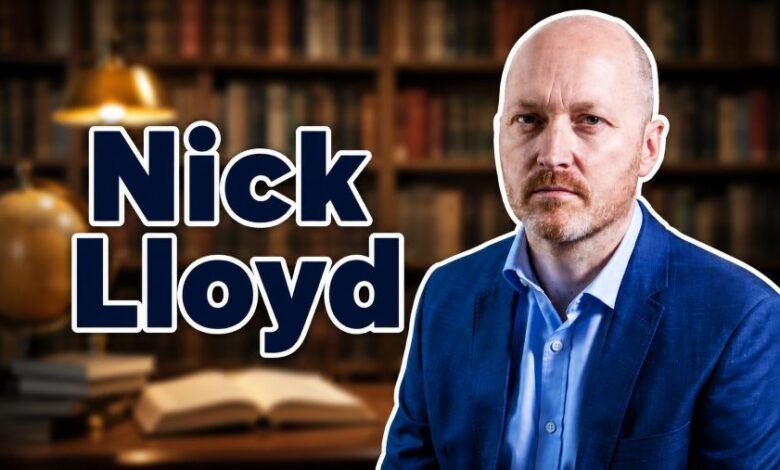
Nick Lloyd is an English military historian, university professor and nonfiction author. He is best known for writing detailed but understandable books about the First World War.
He works as Professor of Modern Warfare in the Defence Studies Department at King’s College London. He is based at the Joint Services Command and Staff College in Shrivenham, Wiltshire.
Lloyd has studied major battles, military leaders, battlefield decisions and the wider political effects of war. His popular books include Passchendaele, The Western Front and The Eastern Front.
His work helps modern readers understand why the First World War happened, how it developed and why its effects can still be seen today.
Nick Lloyd Quick Facts
| Fact | Details |
|---|---|
| Full name | Nicholas Lloyd |
| Professional name | Nick Lloyd |
| Birth year | 1980 |
| Birthplace | Chester, England |
| Nationality | English |
| Profession | Historian, professor and author |
| Current position | Professor of Modern Warfare |
| University | King’s College London |
| Education | University of Birmingham |
| Highest qualification | PhD |
| Main subject | Modern military and imperial history |
| Famous books | Passchendaele, The Western Front and The Eastern Front |
| Main research period | The First World War era |
| Workplace | Joint Services Command and Staff College, Shrivenham |
Who Is Nick Lloyd?
Nick Lloyd is a military historian who studies how wars are planned, fought and remembered.
He mainly focuses on the First World War and the military history of the British Empire. His research covers battles, commanders, military organisations, battlefield technology and the decisions that shaped major campaigns.
Lloyd is different from a battlefield commander or serving military officer. His role is to study evidence, explain past conflicts and help students understand how military decisions can produce long-term consequences.
He teaches in an unusual academic environment. His work at King’s College London is connected with the Joint Services Command and Staff College, where military officers receive professional education.
According to his official King’s College London profile, he is Professor of Modern Warfare in the university’s Defence Studies Department.
Early Life
Nick Lloyd was born in Chester, England, in 1980.
Reliable public profiles do not provide a detailed account of his childhood or early school years. However, his later education shows that he developed a strong interest in history.
This interest eventually led him towards the study of military operations and the First World War.
Military history requires more than remembering battle dates. A historian must understand geography, politics, weapons, leadership, communication, transport and the lives of ordinary soldiers.
Lloyd developed these research skills through university study and doctoral work.
Education at the University of Birmingham
Lloyd studied Medieval and Modern History at the University of Birmingham.
He completed his undergraduate degree in 2001. He then continued studying at the same university and received his PhD in 2005.
His doctoral research examined the British Expeditionary Force and the Battle of Loos.
The Battle of Loos took place in France in 1915 during the First World War. It was one of the largest British attacks of the war’s early period. The battle involved difficult planning, heavy losses and the first major British use of poison gas.
Studying Loos allowed Lloyd to examine important questions about leadership, preparation, tactics and battlefield communication.
His doctoral research later helped form the foundation of his first book.
How Did Nick Lloyd Begin His Academic Career?
Nick Lloyd joined King’s College London in 2006, one year after completing his PhD.
He was first based at the Royal Air Force College Cranwell in Lincolnshire. This position connected his academic research with professional military education.
In July 2007, he moved to the Joint Services Command and Staff College in Shrivenham.
The college forms part of the UK Defence Academy. It provides education and training for officers from the Royal Navy, British Army, Royal Air Force and international armed forces.
Working in this environment gave Lloyd the opportunity to connect historical research with questions faced by modern military professionals.
Over time, he progressed through several academic positions. He became known for his research on military and imperial history before receiving the title of Professor of Modern Warfare.
What Does a Professor of Modern Warfare Do?
A professor of modern warfare studies conflicts from recent centuries.
The work may include examining:
- Why wars begin
- How military plans are created
- Why some battlefield strategies succeed
- Why other operations fail
- How technology changes warfare
- How soldiers and commanders adapt
- How political goals affect military decisions
- How wars change countries and communities
Lloyd teaches, writes books, conducts research and supervises students.
His subjects have included the British Army on the Western Front and the final Hundred Days campaign of 1918.
He has also supervised research connected with colonial warfare, British rule in South Asia, air power and the First and Second World Wars.
Nick Lloyd’s First Book
Lloyd’s first published book was Loos 1915, released in 2006.
The book developed ideas from his doctoral research. It examined the Battle of Loos and questioned some traditional explanations of the campaign.
Rather than describing the battle only as a disaster, Lloyd explored the difficult conditions faced by British commanders and soldiers.
The British Army was expanding quickly at the time. Many troops had limited battlefield experience, while military leaders were learning how to fight a new kind of industrial war.
The battlefield included machine guns, heavy artillery, trenches, gas and complicated communication systems.
Lloyd showed that the battle was part of a wider learning process. The British Army made serious mistakes, but it also gained experience that influenced later operations.
The Amritsar Massacre
In 2011, Lloyd published The Amritsar Massacre: The Untold Story of One Fateful Day.
The book examined the Jallianwala Bagh massacre of 1919 in Amritsar, India.
British troops under Brigadier General Reginald Dyer fired on a large gathering of people, causing many deaths and injuries. The event became one of the most important and painful moments in the history of British rule in India.
Lloyd placed the massacre within the wider political disorder in Punjab during that period.
The book attracted academic debate. Some historians criticised its use of British official records and disagreed with parts of its interpretation.
This disagreement shows how historical writing works. Historians can examine the same event but reach different conclusions because they use different evidence or give more importance to different voices.
Readers should compare several reliable studies when learning about a disputed historical event.
Hundred Days
Lloyd published Hundred Days: The End of the Great War in 2013.
The book covers the final months of the First World War, especially the period between July and November 1918.
During these months, Allied forces launched a series of successful attacks against the German Army.
The campaigns pushed German forces backwards and contributed to the Armistice of 11 November 1918.
Lloyd explains that the war did not simply stop because every army became too tired to continue. Military pressure, political instability, economic difficulties and the weakening of Germany’s allies all played important roles.
The book helps readers understand how the First World War moved from years of deadlock to a fast and decisive ending.
Passchendaele
Passchendaele: A New History was published in 2017.
The book studies the Third Battle of Ypres, one of the most famous campaigns of the First World War.
Passchendaele is often remembered for deep mud, destroyed land and terrible human suffering. Heavy rain and artillery fire turned parts of the battlefield into a dangerous landscape filled with water and shell holes.
Lloyd does not ignore the suffering. However, he also examines the military reasons behind the campaign.
He studies British aims, German defences, battlefield planning and the way tactics changed during the fighting.
The book became a Sunday Times bestseller and brought Lloyd’s work to a wider public audience.
It was also shortlisted for major military-history book awards.
Readers interested in another writer who makes complex history understandable can explore the work of British social historian David Kynaston.
The Western Front
Lloyd published The Western Front: A History of the First World War in 2021.
It became the first book in his planned three-part history of the First World War.
The Western Front was the main battlefield in France and Belgium. It included armies from Britain, France, Germany, the United States and several other countries.
Lloyd explains the fighting from the beginning of the war in 1914 to Germany’s defeat in 1918.
The book covers:
- The German advance through Belgium
- The First Battle of the Marne
- The growth of trench warfare
- The battles of Verdun and the Somme
- The Passchendaele campaign
- The German spring offensives
- The Allied Hundred Days
- The final Armistice
One important part of Lloyd’s work is his use of sources from several countries.
He does not tell the story only from the British side. He also examines French, German and American experiences.
This wider approach helps readers understand that every army faced fear, confusion, supply problems and changing battlefield conditions.
The Eastern Front
The second book in Lloyd’s First World War series, The Eastern Front, was published in 2024.
The Eastern Front covered a huge area of Europe.
Fighting took place across regions connected with modern Poland, Ukraine, Belarus, Russia, Romania, Serbia and the Baltic states.
The book explains the roles of several powerful empires:
- The Russian Empire
- The German Empire
- Austria-Hungary
- The Ottoman Empire
Unlike the Western Front, the eastern battlefield had greater distances and more movement. Armies sometimes advanced or retreated across large areas.
The fighting contributed to the collapse of the Russian, German, Austro-Hungarian and Ottoman empires.
It also helped create new borders, countries and political conflicts.
The Eastern Front became a New York Times bestseller and received international attention from historians and book reviewers.
Nick Lloyd’s First World War Trilogy
Lloyd’s planned First World War trilogy is designed to explain the conflict across its major theatres.
The series includes:
- The Western Front
- The Eastern Front
- The Wider War
The planned third book is expected to explore fighting in Africa, the Middle East and other regions beyond Europe’s two best-known fronts.
This structure is important because the First World War was a global conflict.
Soldiers, workers and civilians from Africa, Asia, Australia, New Zealand, Canada, the Caribbean and many other regions were involved.
Looking only at France and Belgium cannot provide the complete story.
Complete List of Nick Lloyd’s Books
Nick Lloyd’s published books include:
- Loos 1915 — 2006
- The Amritsar Massacre — 2011
- Hundred Days — 2013
- Passchendaele: A New History — 2017
- The Western Front — 2021
- The Eastern Front — 2024
These books show the development of his career.
His earliest work focused on individual battles. His later books examine entire fighting fronts and large international events.
What Makes Nick Lloyd’s Writing Different?
Lloyd combines academic research with clear storytelling.
Military history can become difficult when it contains too many unit names, battlefield maps and technical terms. Lloyd tries to explain these details while keeping the larger story visible.
His writing commonly focuses on:
- Command decisions
- Military planning
- Battlefield movement
- Changing technology
- Supply and transport
- Communication problems
- Political pressure
- The experiences of different armies
- The connection between battles and wider history
He also questions simple historical ideas.
For example, the First World War is sometimes described as a conflict in which nothing changed and every general repeated the same mistakes.
Lloyd shows that armies learned and adapted. Weapons, tactics, training and communication developed throughout the war.
This does not mean that every decision was correct. It means the real history was more complicated than a simple story of good or bad leadership.
Why Does Nick Lloyd Study Military Leaders?
Commanders make decisions that can affect thousands or even millions of people.
A general must work with limited information. Maps may be incomplete, messages may arrive late and enemy plans may remain hidden.
Weather, damaged roads, equipment problems and exhausted soldiers can also change an operation.
Lloyd studies commanders to understand the choices available to them at a particular moment.
This approach does not automatically excuse poor decisions. Instead, it helps readers judge those decisions using the conditions that existed at the time.
Teaching Military History
Teaching is an important part of Lloyd’s career.
His students include people studying defence, security, military operations and history.
Military education often uses past campaigns as learning tools. Students study what happened, why it happened and what could have been done differently.
Historical cases can help future leaders think carefully about planning, uncertainty and responsibility.
However, history does not provide a simple instruction book. Every conflict is different.
A lesson from 1916 cannot be copied directly into a modern situation. It can still help students ask better questions about leadership, preparation and risk.
Nick Lloyd’s Research on the British Army
A major part of Lloyd’s work examines how the British Army changed during the First World War.
Britain entered the conflict with a relatively small professional army.
As the war continued, millions of men joined or were called into service. The army had to grow very quickly.
It needed to train soldiers, create new units, produce weapons and build supply systems.
It also had to learn how to break through strong defensive positions protected by trenches, artillery, machine guns and barbed wire.
Lloyd’s research follows this difficult transformation.
By 1918, the British Army could coordinate infantry, artillery, aircraft and tanks more effectively than it could during the war’s early years.
Public Recognition
Lloyd’s books have received attention from newspapers, history publications and academic reviewers.
Passchendaele became a Sunday Times bestseller and was shortlisted for important military-book honours.
The Western Front was selected as a notable book of the year by major British newspapers.
The Eastern Front later became a New York Times bestseller.
This recognition shows that his work reaches both specialist historians and general readers.
Academic historians may examine his evidence and arguments. General readers may use his books to gain a clear understanding of complicated campaigns.
Is Nick Lloyd Still Teaching?
Yes. As of July 2026, Nick Lloyd is listed by King’s College London as Professor of Modern Warfare.
He remains connected with the Defence Studies Department and the Joint Services Command and Staff College.
His academic work includes research, teaching and supervision.
Why Is Nick Lloyd Important?
Nick Lloyd is important because he helps readers see the First World War as a changing global conflict.
His books explain that battles were connected with politics, technology, geography and the collapse of powerful empires.
He also brings attention to areas that are sometimes missing from popular accounts.
The Eastern Front affected millions of people and helped reshape Europe, yet it often receives less attention in English-language history than the Western Front.
By examining both fronts, Lloyd gives readers a broader view of the conflict.
His work also supports professional military education. It encourages students to study past decisions carefully rather than accepting simple myths.
Readers who enjoy learning about modern British writers can also read about British novelist Naomi Ishiguro and her journey through literary and fantasy fiction.
Frequently Asked Questions
What is Nick Lloyd famous for?
Nick Lloyd is famous for writing military-history books about the First World War. His best-known works include Passchendaele, The Western Front and The Eastern Front.
What does Nick Lloyd do?
He is a historian, author and Professor of Modern Warfare at King’s College London.
When was Nick Lloyd born?
He was born in 1980. Reliable institutional sources do not publicly list his complete date of birth.
Where was Nick Lloyd born?
He was born in Chester, England.
Where did Nick Lloyd study?
He studied Medieval and Modern History at the University of Birmingham. He later completed a PhD there in 2005.
What was Nick Lloyd’s PhD about?
His doctoral research examined the British Expeditionary Force and the Battle of Loos during the First World War.
What was Nick Lloyd’s first book?
His first book was Loos 1915, published in 2006.
How many books has Nick Lloyd written?
He had published six books by July 2026.
What is Nick Lloyd’s latest published book?
His latest published book is The Eastern Front, released in 2024.
What is The Eastern Front about?
The book explains the First World War in Eastern Europe and the Balkans. It studies the fighting that contributed to the collapse of several empires.
Is Nick Lloyd writing another book?
A third First World War volume titled The Wider War has been announced. It is expected to cover the conflict in Africa, the Middle East and other global theatres.
Is Nick Lloyd a military officer?
Reliable public profiles describe him as an academic historian and professor. They do not identify him as a serving military officer.
Where does Nick Lloyd work?
He works for King’s College London and is based at the Joint Services Command and Staff College in Shrivenham, Wiltshire.
What subjects does Nick Lloyd teach?
His teaching and research cover modern warfare, military history, imperial history and the First World War.
Why should people read Nick Lloyd’s books?
His books make complicated military campaigns easier to understand. They also use evidence from different countries to present a wider view of war.
Conclusion
Nick Lloyd has built an important career by studying warfare carefully and explaining it clearly.
His journey began with university research on the Battle of Loos. It later developed into major books about Passchendaele, the Western Front and the Eastern Front.
His work shows that the First World War cannot be understood through one battle, one country or one simple explanation.
It was a global conflict shaped by military decisions, political pressure, new technology and the actions of millions of people.
Through his books and teaching, Lloyd helps readers understand how the conflict developed and why it changed the modern world.