

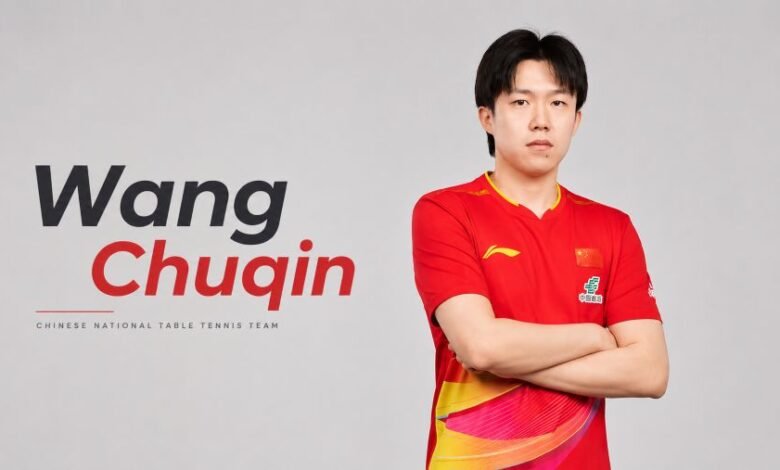
Introduction
Wang Chuqin’s career is now defined by an unusual contrast. He reached the top of the world rankings before winning either of table tennis’s biggest individual world titles, suffered a stunning early singles exit at the Paris Olympics, then answered that disappointment by becoming World Champion in 2025 and World Cup champion in 2026.
That sequence matters. Wang is no longer simply one of China’s leading players or a gifted doubles specialist. As of ITTF Week 35 in August 2026, he is ranked World No. 1 in men’s singles, while his 2025 World Championships and 2026 World Cup victories mean that only an Olympic men’s singles title is missing from the traditional trio of major individual crowns.
His record is already substantial: two Olympic gold medals, a men’s singles world championship, a World Cup singles title, three consecutive mixed-doubles world titles with Sun Yingsha, multiple team world championships and four gold medals from a single Asian Games.
Yet his story is more interesting than the medal count. It includes rapid progress, disciplinary trouble, major defeats, tactical evolution and the pressure that comes with leading Chinese men’s table tennis.
Quick Facts About Wang Chuqin
| Fact | Details |
|---|---|
| Full name | Wang Chuqin |
| Chinese name | 王楚钦 |
| Date of birth | 11 May 2000 |
| Nationality | Chinese |
| Height | Listed at 1.80 m by the Hangzhou Asian Games |
| Playing hand | Left-handed |
| Grip | Shakehand |
| Playing style | Attacking |
| Current singles ranking | World No. 1, ITTF Week 35, August 2026 |
| Olympic gold medals | Mixed doubles and men’s team, Paris 2024 |
| World singles champion | 2025 |
| World Cup singles champion | 2026 |
| Mixed doubles partner | Sun Yingsha |
| Asian Games highlight | Four gold medals at Hangzhou 2023 |
Wang’s official Asian Games profile gives his birth date as 11 May 2000, lists him at 1.80 metres, identifies him as a left-handed shakehand attacker and records that he began playing table tennis at the age of seven.
From a Young Prospect to China’s Senior Team
Wang’s rise began long before he became a familiar face at Olympic and World Championship finals.
The official Asian Games record shows a career that moved quickly from youth competition into senior success. By 2018, Wang had already won the Youth Olympic Games men’s singles title and was part of China’s World Championships men’s team triumph. A year later, he partnered Ma Long to win the 2019 World Championships men’s doubles title.
His singles progress was becoming increasingly visible too. In 2019, Wang won his first ITTF World Tour men’s singles title in Sweden. That result mattered because it showed that he could succeed independently, rather than only as part of China’s formidable team or doubles combinations.
The path was not completely smooth.
The 2019 Suspension Was an Important Early Setback
In November 2019, the Chinese Table Tennis Association suspended Wang for three months after an incident at the Austrian Open.
Wang had lost a seven-game match to Chinese teammate Zhao Zihao. During the contest, he threw his racket at the table, conduct the association regarded as a breach of sporting ethics. His coach, Liu Guozheng, received a one-month suspension. Wang was ordered to return to China and withdrew from his remaining events.
The incident is relevant because it provides a documented example of the emotional pressure surrounding his early career. It should not be exaggerated into a defining character judgment. Wang served the sanction and subsequently returned to international competition, eventually taking on far greater responsibilities within the Chinese national team.
His later career would be shaped less by disciplinary questions and more by whether he could convert enormous technical ability into the sport’s biggest singles titles.
Becoming World No. 1 Before Becoming World Champion
Wang officially reached World No. 1 for the first time on 4 July 2023.
The ranking change ended Fan Zhendong’s run of 142 consecutive weeks at the top. ITTF explained that expiring ranking points from previous events contributed to the change, while Wang’s own results during the first half of 2023 had added substantial points to his total.
That distinction is important. A world ranking measures performance across qualifying tournaments and time periods; it is not the same thing as winning the World Championships.
When Wang first reached No. 1, he had just finished runner-up to Fan Zhendong in men’s singles at the 2023 World Championships in Durban. He was therefore the world’s highest-ranked player without yet being the reigning world singles champion.
That gap between ranking status and championship success became one of the central questions of his career.
Four Gold Medals Changed His Status at the 2023 Asian Games
The Hangzhou Asian Games later in 2023 provided perhaps the clearest early evidence of Wang’s versatility.
He won four gold medals: men’s singles, men’s team, men’s doubles with Fan Zhendong and mixed doubles with Sun Yingsha. The Olympic Council of Asia records all four titles, while Xinhua described Wang as the first male table tennis player to win four gold medals at a single Asian Games.
The singles title carried particular weight.
Wang defeated Fan Zhendong 4–3 in a tense final. Before that match, Fan held a 9–2 international head-to-head advantage over Wang and had beaten him in all three of their meetings earlier that year, including the World Championships final.
Wang’s victory therefore represented more than another medal. He had beaten the established world champion in a major final after repeatedly losing that matchup.
It also came only weeks after a severe disappointment. Wang had suffered an early defeat to Japan’s Yuta Tanaka at the Asian Championships and later told Xinhua that the result caused him to question himself. His four-title response in Hangzhou showed how quickly elite table tennis can reverse a player’s competitive narrative.
Wang Chuqin and Sun Yingsha Became a Historic Mixed-Doubles Partnership
Wang’s singles achievements receive most of the attention, but his partnership with Sun Yingsha is fundamental to understanding his career.
Together, Wang and Sun won mixed-doubles world titles in 2021, 2023 and 2025, becoming champions at three consecutive World Championships. In the 2025 final in Doha, they defeated Japan’s Maharu Yoshimura and Satsuki Odo 3–1.
Their biggest shared title came at the Paris Olympics.
Wang and Sun defeated North Korea’s Ri Jong Sik and Kim Kum Yong 4–2 in the 2024 Olympic mixed-doubles final, earning China’s first Olympic gold medal in the event. Mixed doubles had only been introduced to the Olympic table tennis programme at Tokyo, where China had failed to win the inaugural title.
For Wang, it was his first Olympic gold.
He later added another in the men’s team event, making Paris both a successful Olympics and a deeply frustrating one.
Paris 2024 Brought Two Gold Medals—and a Major Singles Shock
Wang entered the Paris men’s singles tournament as one of the favourites. Instead, his campaign ended in the Round of 32 against Sweden’s Truls Möregårdh.
The result was one of the tournament’s biggest upsets. Reuters reported that Wang, then World No. 1, was eliminated shortly after winning mixed-doubles gold.
The defeat became even more widely discussed because of something that happened the previous day.
After the mixed-doubles final, photographers accidentally damaged Wang’s preferred racket while moving around the courtside area. Wang was visibly unhappy but said he would continue with a backup racket.
Those two events are often presented online as cause and effect: racket broken, therefore Wang lost.
The available evidence does not justify that conclusion.
After the Möregårdh match, Wang pointed instead to his own errors and poor performance. Reuters reported that he did not use the damaged racket as an excuse.
A careful biography should therefore separate what is known from what is assumed. The racket was damaged. Wang then lost. There is no reliable evidence establishing that the first event caused the second.
Paris remained successful overall because Wang left with gold medals in mixed doubles and men’s team competition. But the singles defeat created a clear unresolved question: could the world’s top-ranked player win one of the sport’s defining individual championships?
Doha 2025 Gave Wang His First World Singles Title
The answer arrived on 25 May 2025.
At the World Championships in Doha, Wang defeated Brazil’s Hugo Calderano 4–1 in the men’s singles final, winning 12–10, 11–9, 4–11, 11–2 and 11–7. It was Wang’s first World Championships singles title.
The result carried several layers of significance.
Calderano had defeated Wang only weeks earlier in the 2025 World Cup semifinals, recovering from a 1–3 deficit. In Doha, Wang reversed that result convincingly. ITTF’s match analysis described Wang using heavy topspin and repeatedly targeting Calderano’s crossover area between forehand and backhand, limiting the Brazilian’s ability to establish his attacking rhythm.
Wang also became the first left-handed men’s singles World Champion since France’s Jean-Philippe Gatien in 1993.
For a player who had already been World No. 1 and Asian Games champion, this was the result that removed one of the largest gaps from his résumé.
His 2026 World Cup Victory Completed the Next Step
Another gap disappeared less than a year later.
At the 2026 ITTF Men’s World Cup in Macao, Wang won his first World Cup singles title, defeating Japan’s Sora Matsushima 4–3 in the final. Matsushima led 3–2 before Wang took the sixth game 11–4 and the deciding seventh 11–8.
His path through the tournament made the victory particularly revealing.
In the quarterfinals, Wang trailed Slovenia’s Darko Jorgić 1–3 before recovering to win 4–3. In the semifinal, he defeated defending champion Hugo Calderano 4–1, avenging the previous year’s World Cup loss.
Those matches matter because they provide tangible evidence of Wang succeeding under very different forms of pressure: surviving from behind, adjusting against an opponent who had recently beaten him, and closing out a seven-game final.
With the World Championships and World Cup singles titles now secured, an Olympic men’s singles gold remains the major individual title still missing from his career.
What Makes Wang Chuqin’s Playing Style Effective?
Wang is a left-handed, shakehand-grip attacking player whose game places heavy value on gaining initiative early in a point.
A 2026 study by Chyong-Huoy Huang in the International Journal of Racket Sports Science analysed Wang’s 2023 World Championships matches using a double three-phase tactical model. The research examined 16 games from his quarterfinal, semifinal and final.
The study found that Wang’s serve-and-attack phase consistently produced high scoring efficiency. His service variation, spin and placement helped him create strong third-ball attacking opportunities. In contrast, the analysis identified more variable performance when points developed into longer rallies, particularly against elite opponents who could neutralise his first attacks.
That does not mean Wang is incapable in rallies. The study analysed only three matches from one tournament, so it should not be treated as a permanent description of every stage of his career. Its value is narrower: it provides quantitative support for what match observation often shows—Wang is especially dangerous when he can impose himself during the first few strokes.
The 2025 World Championship final offered a practical example. Against Calderano, Wang used early pressure, heavy topspin and targeted placement to prevent his opponent from comfortably initiating his own attacking patterns.
Being World No. 1 Does Not Make Wang Untouchable
Wang returned to the top of the world rankings in September 2025 after winning WTT Champions Macao. ITTF reported that it was his first week back at No. 1 since February and that his previous spell at the summit had lasted 47 consecutive weeks.
By Week 35 of the 2026 rankings, he was again listed as the men’s singles World No. 1.
Yet recent results show why ranking dominance should not be confused with invincibility.
At the 2026 United States Smash, Denmark’s Anders Lind defeated Wang 3–1 in the Round of 16, ending his attempt to win a third consecutive Grand Smash singles title. Lind had also beaten Wang at China Smash in 2024.
Sora Matsushima has also emerged as a serious challenge, pushing Wang to seven games in the World Cup final. Hugo Calderano has already demonstrated his ability to defeat Wang at the highest level, while Truls Möregårdh’s Paris victory remains one of the clearest reminders of the depth of the international field.
That broader competition makes Wang’s current position more interesting, not less. He is leading men’s table tennis during a period in which elite challengers are emerging from Europe, Japan and the Americas.
China Still Relies on Wang When Team Titles Are at Stake
Wang’s importance extends beyond individual tournaments.
At the 2026 World Team Table Tennis Championships in London, China experienced an unusually difficult campaign, including group-stage defeats to Korea Republic and Sweden. Wang was not used in the loss to Korea, but became central during the knockout rounds.
In the semifinal against France, he won both of his matches, including the decisive fourth contest against Félix Lebrun. In the final against Japan, Wang defeated Sora Matsushima as China won 3–0 and captured its record 24th men’s world team title.
ITTF later noted that Wang finished the knockout stages unbeaten.
This is another important part of his profile. China’s expectations for elite players are not limited to personal rankings. They are also expected to perform when national team titles are under pressure.
What Comes Next for Wang Chuqin?
At 26, Wang is already a World Champion, World Cup champion, two-time Olympic gold medallist and World No. 1.
But one achievement could significantly change how his singles career is ultimately judged.
He has never won Olympic men’s singles gold.
Paris 2024 ended in the Round of 32, while his Olympic titles came in mixed doubles and the men’s team event. That makes the next Olympic cycle especially important. If Wang were eventually to add an Olympic singles title to his World Championships and World Cup victories, he would complete the traditional collection of table tennis’s three premier men’s singles crowns.
There is no guarantee he will do so. Table tennis rankings can move quickly, China’s domestic competition for Olympic places is unusually intense, and players such as Matsushima, Calderano, Möregårdh, the Lebrun brothers and others continue to challenge the established order.
That uncertainty is precisely what makes the next stage compelling.
Final Perspective
Wang Chuqin’s career cannot be understood properly through rankings alone.
He became World No. 1 before becoming World Champion. He won two Olympic gold medals in Paris while simultaneously suffering one of his most painful singles defeats. He lost to Hugo Calderano at the 2025 World Cup, then beat the Brazilian for the world title weeks later. In 2026, he finally won the World Cup after surviving two seven-game battles.
The pattern is not uninterrupted dominance. It is repeated adjustment.
That may be the clearest way to understand Wang’s position in modern table tennis. His strongest achievements have often arrived after moments that exposed what was still missing from his game or résumé.
As of August 2026, he stands at World No. 1 with both the World Championships and World Cup singles trophies secured.
The remaining question is unusually specific: whether Wang Chuqin can eventually turn his Olympic success in doubles and team competition into the men’s singles gold that would complete the defining set of individual titles.
Short FAQs
Who is Wang Chuqin?
Wang Chuqin is a Chinese professional table tennis player and the men’s singles World No. 1 as of ITTF Week 35 in August 2026. He is a World Championships singles champion, World Cup champion and two-time Olympic gold medallist.
How old is Wang Chuqin?
Wang Chuqin was born on 11 May 2000, making him 26 years old in August 2026.
Is Wang Chuqin World No. 1?
Yes. He is listed at No. 1 in the men’s singles rankings for ITTF Week 35 of 2026.
How many Olympic gold medals does Wang Chuqin have?
Wang won two gold medals at Paris 2024: mixed doubles with Sun Yingsha and men’s team gold with China.
Did Wang Chuqin win Olympic men’s singles gold?
No. Truls Möregårdh eliminated Wang in the Round of 32 at Paris 2024.
Who is Wang Chuqin’s mixed-doubles partner?
His long-standing mixed-doubles partner is Sun Yingsha. Together they won the 2024 Olympic title and three consecutive World Championships in 2021, 2023 and 2025.
Has Wang Chuqin won the World Championships?
Yes. He won his first men’s singles World Championship in Doha in 2025, beating Hugo Calderano 4–1 in the final.
Has Wang Chuqin won the World Cup?
Yes. Wang won his first men’s singles World Cup in Macao in April 2026, defeating Sora Matsushima 4–3 in the final.
Did the broken racket cause Wang’s Paris 2024 singles defeat?
There is no reliable evidence proving that. His preferred racket was accidentally damaged after the mixed-doubles final, but after losing to Möregårdh, Wang focused on his own mistakes and performance rather than blaming the replacement racket.