

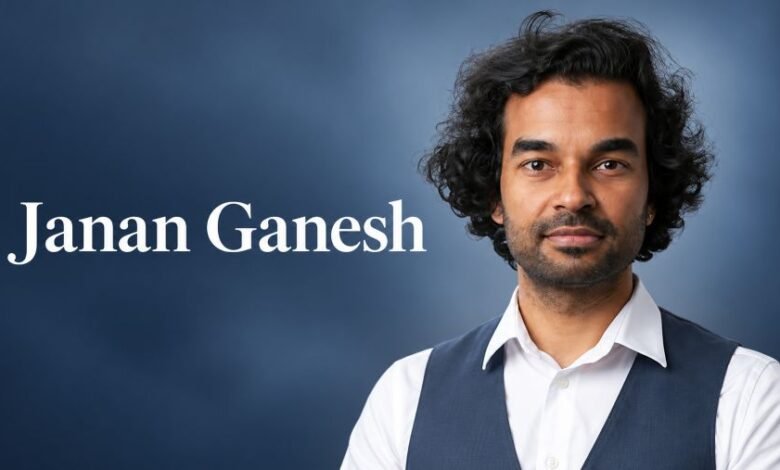
Janan Ganesh: The Writer Who Moved From Westminster Policy to Global Commentary
From Policy Exchange and The Economist to a senior Financial Times role, Janan Ganesh has built a career around politics, public affairs, and cultural commentary.

Introduction
Janan Ganesh is a British journalist, author, and political commentator best known for his work at the Financial Times. As of October 2026, he works as a biweekly columnist and associate editor at the newspaper.
His career did not start in a newsroom. It began closer to Westminster policy.
Ganesh worked at Policy Exchange, later spent around five years as a political correspondent at The Economist, then joined the Financial Times in 2012. Since then, his writing has moved from British politics into US affairs, international politics, culture, and lifestyle.
That career path matters. It explains his style.
He knows policy. He knows Westminster. And he writes for a wider audience.
Quick Facts
| Detail | Information |
|---|---|
| Full Name | Janan Ganesh |
| Born | 1982 |
| Profession | Journalist, columnist, author, political commentator |
| Current Organisation | Financial Times |
| Current Position | Biweekly columnist and associate editor |
| Main Subjects | International politics, global affairs, culture |
| Former Employer | The Economist |
| Earlier Workplace | Policy Exchange |
| University | University of Warwick |
| Degree | BA in Politics |
| Postgraduate Study | Public policy at University College London |
| Published Book | George Osborne: The Austerity Chancellor |
| Co-authored Work | Compassionate Conservatism: What It Is, Why We Need It |
Who Is Janan Ganesh?
Janan Ganesh is mainly known as a political columnist.
But that description is quite narrow.
His professional record includes policy research, political reporting, book writing, television commentary, British politics, American politics, and later international affairs.
Right now, his main platform is the Financial Times.
His FT work often looks at politics through a wider lens. Elections matter, of course. So do institutions, cities, culture, economics, leadership, and changes in Western public life.
That mix gives his work a different feel from daily political reporting.
He is usually analysing rather than chasing breaking news.
Early Background and Education
Ganesh was born in 1982.
A 2001 Guardian report connected the then 19-year-old student with Croydon in South London. That gives a useful public reference to his early years without guessing at private family details.
His academic record is much clearer.
Ganesh studied Politics at the University of Warwick.
Policy Exchange later reported that he finished top of his year. That is a strong academic result, and it also fits the direction his career soon took.
He then studied public policy at University College London.
His work there had a particular focus on health policy.
So, basically, his professional interests appeared early: politics, government, policy, and how public systems work.
Starting Out at Policy Exchange
Before national journalism, Ganesh worked at Policy Exchange.
He served there as a research fellow during the mid-2000s.
This was an important early step.
Policy Exchange is a Westminster-based think tank, and the role gave him direct experience with public-policy research before he became widely known as a newspaper columnist.
His work included research connected with healthcare policy and public-sector performance.
A 2007 Policy Exchange publication, Measure for Measure, listed him among its researchers and authors.
He had also worked for Zac Goldsmith, according to his contemporary Policy Exchange profile.
This part of his career helps explain something important.
Ganesh entered journalism with policy experience already behind him.
He was not learning Westminster from zero.
Compassionate Conservatism
In 2006, Ganesh co-authored Compassionate Conservatism: What It Is, Why We Need It with Jesse Norman.
The work was published through Policy Exchange.
It appeared during a period when David Cameron’s Conservative Party was trying to change how it presented its political ideas to the public.
The book discussed a form of conservatism centred on society, community, civic institutions, and limits on the role of the state.
That made Ganesh part of a wider intellectual conversation around British Conservative politics at the time.
It does not mean every argument in that book should be treated as his current political position. Views can change. Careers do too.
That distinction matters.
Recognition as a Young Writer
Ganesh received the T. E. Utley Memorial Prize for young journalists in 2006.
Policy Exchange recorded the award in its own author material.
It came early.
He was still building his career, yet his writing was already gaining notice.
Soon after, journalism became his main professional path.
Five Years at The Economist
Ganesh later joined The Economist.
He spent around five years as a political correspondent there.
This was the point where policy research gave way to full-time political journalism.
The move made sense.
He already understood policy debates. Now he was reporting and writing about the politicians, institutions, and arguments behind them.
The Economist also placed him inside one of the best-known international publications covering politics, economics, and public affairs.
That experience set up his next move.
Joining the Financial Times
Ganesh joined the Financial Times in 2012.
His early FT work became closely tied to British politics.
But the beat did not stay fixed.
Over time, he wrote more about the United States and worked as the FT’s US politics columnist, including periods based in Washington and Los Angeles.
Then his scope widened again.
By 2026, his work was centred on international politics and global affairs, while his FT Weekend writing also covered culture and lifestyle.
That is a fairly unusual mix.
One column might deal with political power. Another may look at cities, food, social habits, travel, or cultural taste.
Still, the voice stays recognisable.
George Osborne: The Austerity Chancellor
Also in 2012, Ganesh published George Osborne: The Austerity Chancellor through Biteback Publishing.
The book examined Osborne’s rise in British politics and his role as Chancellor of the Exchequer.
It came at a sensitive political moment.
Austerity was a major issue in Britain, and Osborne was one of the central figures associated with the government’s economic programme.
Ganesh’s book received press attention and reviews across British media.
Some reviewers praised the level of research. Others argued that the account was too sympathetic to its subject.
That disagreement is useful context.
The book was clearly being read as serious political work, not a lightweight profile.
Television and Political Commentary
Ganesh also appeared regularly on British political television.
BBC material from 2016 recorded 32 appearances on Sunday Politics during the period reviewed by the broadcaster.
That is a substantial number.
His television work placed him alongside journalists, politicians, and commentators discussing the week’s political events.
A BBC programme transcript from 2017 also confirms his presence on a Sunday Politics panel.
So his public work was not limited to print.
For a period, he became a familiar face in televised political discussion too.
From British Politics to the United States
One of the bigger changes in Ganesh’s career came when his focus shifted beyond Westminster.
He became closely associated with US political commentary for the Financial Times.
His work took him to the United States, including Washington and Los Angeles.
That changed the scale of his subject matter.
Instead of writing mainly about British parties and politicians, he could compare political behaviour across countries, examine American institutions, and look at wider changes affecting Western democracies.
Later, his FT remit became broader again.
International politics became the main frame.
What Does Janan Ganesh Write About Now?
As of October 2026, Ganesh remains active at the Financial Times.
His current role is described as biweekly columnist and associate editor.
His political writing now deals heavily with international affairs.
But politics is only part of the picture.
Ganesh has also written about culture and lifestyle for FT Weekend.
He explained this split himself in a 2022 interview, describing one side of his work as politics and the other as culture and lifestyle.
Actually, that combination makes his current position easier to understand.
He is not a political reporter in the traditional daily-news sense.
He is a columnist.
The job gives him more room to form arguments, compare places, question assumptions, and write about subjects that sit outside party politics.
His Writing Career in Simple Terms
The timeline is clear.
Ganesh began around policy research.
Then came political journalism.
After that, long-form commentary.
His career can be traced through several confirmed stages:
Policy Exchange → The Economist → Financial Times → UK politics → US politics → international politics and culture
It is a neat progression, but not a straight one.
The subjects kept widening.
That may be the most useful way to understand his career.
Publicly Confirmed Personal Information
There is plenty of public information about Ganesh’s professional life.
His private life is different.
Reliable public sources do not provide enough strong evidence to support claims about a spouse, children, parents, salary, personal wealth, height, or similar private details.
Those claims are often repeated on low-quality profile sites.
They should not be treated as established facts.
So they are left out here.
Simple rule: verified facts only.
Why His Career Stands Out
Ganesh has worked on both sides of political analysis.
First came policy research.
Then journalism.
That background gives his career a clear base.
He has also moved across different types of political writing without becoming tied to a single beat for his whole career.
Britain came first.
The United States followed.
Now the scope is international.
Culture sits beside it.
That range has helped make him one of the Financial Times writers whose work reaches beyond ordinary political reporting.
Final Thought
Janan Ganesh built his public career through research, reporting, books, television commentary, and newspaper columns.
The Financial Times is now his main professional home.
As of October 2026, he works there as a biweekly columnist and associate editor, writing mainly about international politics while also covering cultural subjects for FT Weekend.
His route into journalism is equally interesting.
Policy came first. Reporting came next.
Then the world got bigger.
Frequently Asked Questions
Who is Janan Ganesh?
Janan Ganesh is a British journalist, author, and political commentator. He is best known for his work at the Financial Times.
What does Janan Ganesh do now?
As of October 2026, he works as a biweekly columnist and associate editor at the Financial Times.
Where did Janan Ganesh study?
He studied Politics at the University of Warwick and later studied public policy at University College London.
Did Janan Ganesh work for The Economist?
Yes. He spent around five years working as a political correspondent for The Economist before joining the Financial Times.
When did Janan Ganesh join the Financial Times?
He joined the Financial Times in 2012.
What books has Janan Ganesh written?
He wrote George Osborne: The Austerity Chancellor. He also co-authored Compassionate Conservatism: What It Is, Why We Need It with Jesse Norman.
What does Janan Ganesh write about?
His current work mainly covers international politics and global affairs. He also writes about culture and lifestyle for FT Weekend.
Is Janan Ganesh married?
Reliable authoritative sources reviewed for this profile do not provide enough evidence to make a verified statement about his current marital status, so no claim is made here.