Target Company URL Research: How to Find and Verify Official Business Websites
A practical guide to finding company URLs, checking business identities, and building accurate company research records.

Introduction
Finding a company’s website sounds easy. Search its name, open the first result, and copy the address.
But what happens when three businesses share the same name? Or when a company changes its website, operates under a different brand, or has several regional domains?
That’s where Target Company URL Research becomes useful.
It helps sales professionals, recruiters, business analysts, and researchers identify the correct websites of companies they want to investigate.
The goal is simple: find the right business, confirm its official website, and collect dependable information before making decisions.
Quick Facts About Target Company URL Research
| Feature | Details |
|---|---|
| Research Type | Company website identification |
| Main Purpose | Find and verify official business URLs |
| Common Users | Sales teams, recruiters, analysts, marketers |
| Key Information | Company name, domain, location, industry |
| Research Methods | Search engines, business databases, official records |
| Verification | Website details and independent sources |
| Common Output | Company research spreadsheet or report |
| Main Benefit | More accurate business information |
What Is Target Company URL Research?
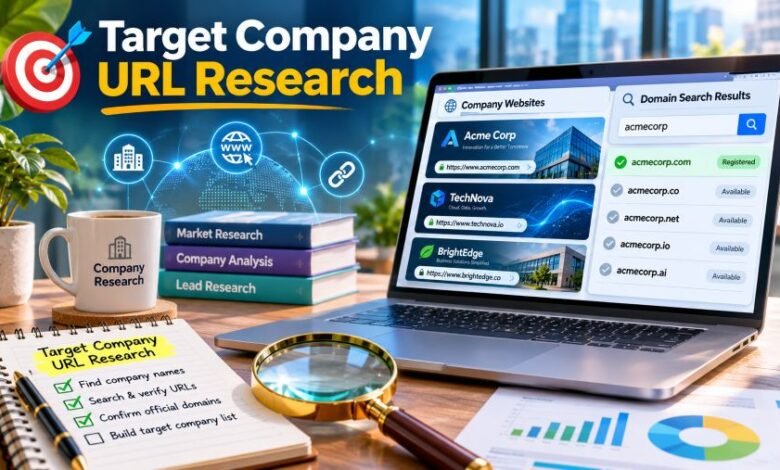
Target Company URL Research is the process of identifying and verifying the official website address of a particular business.
Here, the word “target” means the company selected for investigation.
It does not necessarily refer to Target Corporation, the American retail company.
For example, imagine a sales professional receives a spreadsheet containing 150 business names.
Some companies have recognizable names. Others are small manufacturers, regional service providers, or recently established businesses.
Finding the correct website for every organization becomes a research task.
A proper investigation involves identifying possible domains, comparing company details, and confirming which website represents the intended business.
This information can then support sales outreach, competitor research, recruitment, or commercial due diligence.
Why Is Company URL Research Important?
A company’s website is often the starting point for understanding its business activities.
An accurate domain can lead researchers to useful information about products, services, leadership, locations, and contact channels.
But an incorrect URL can create several problems.
Better Business Identification
Businesses sometimes operate under similar or identical names.
Checking their industry, headquarters, and legal identity helps distinguish one organization from another.
More Accurate Sales Prospecting
Sales professionals need dependable company information before approaching potential customers.
A verified website helps them understand what a prospect sells and whether its services match their target market.
Improved Competitor Research
Marketing teams often study competitors’ websites to understand their products, content, pricing, and positioning.
Researching the wrong domain can produce misleading conclusions.
Cleaner Business Databases
Company databases frequently contain duplicate records, outdated websites, or missing domain information.
Consistent URL research helps identify these issues and makes customer relationship management records more useful.
How to Conduct Target Company URL Research
A careful process works better than copying the first result from a search engine.
Step 1: Identify the Exact Company
Start with the business name.
If possible, collect supporting details such as its location, industry, legal name, and known products.
Consider this fictional example:
- Company name: Northbridge Technology Solutions
- Country: United Kingdom
- Industry: IT services
- Research objective: Identify the official company website
These details narrow the search and reduce confusion with unrelated businesses.
Step 2: Search for Possible Websites
Use a search engine to look for the company’s official presence.
Search queries might include:
- Company name + official website
- Company name + city
- Company name + industry
- Company name + contact information
Compare several relevant results rather than selecting the first listing automatically.
Business directories and professional profiles can help identify possible domains, but they should not be treated as final proof.
Step 3: Examine the Website
Open the most promising result.
Look for information that connects the website to the company.
Useful pages include the homepage, About Us section, Contact page, product pages, legal notices, and published company reports.
Check whether the business name, services, and geographical information match your existing research.
A website with a similar name is not automatically the correct website.
Step 4: Verify the Business Identity
Independent verification is particularly important when the company has a common name.
For UK businesses, Companies House provides access to registered company information.
For companies that submit filings to the US Securities and Exchange Commission, the EDGAR database can provide useful corporate records.
Researchers can compare information from these sources with the business’s website.
However, registration records do not automatically prove that a particular domain belongs to a company.
Step 5: Check the Domain
A domain name is not the same as an entire website URL.
For example:
Domain: example.com
Homepage URL: https://www.example.com/
Specific page URL: https://www.example.com/about
Understanding the difference matters when organizing research databases.
You can also investigate domain registration information through ICANN’s registration data lookup service.
This may reveal registration-related details, although some information can be unavailable or protected.
Domain registration data should be treated as supporting evidence rather than conclusive proof of business ownership.
Step 6: Record and Review the Results
Once a website has been checked, record the result in a spreadsheet or research database.
Useful columns include:
| Field | Example |
|---|---|
| Company Name | Northbridge Technology Solutions |
| Industry | IT Services |
| Country | United Kingdom |
| Official Domain | Pending verification |
| Website Status | Under review |
| Confidence Level | Low / Medium / High |
| Verification Source | Company website and public records |
| Last Checked | 5 November 2026 |
This is an illustrative research record, not information about a verified real company.
Record unresolved results as unresolved. An empty field is better than a misleading URL.
How Do Company URL Research Tools Work?
Some online services are designed to find company websites from lists of business names.
They may compare business names with company databases and return possible matching domains.
Certain tools also support batch searches, confidence scores, and CSV exports.
For example, the website operating as Target Company URL Research describes a company-name lookup process that returns suggested domains.
These services can reduce manual searching.
However, an automated match is not the same as verified ownership.
A high match score may only indicate that a company name closely resembles a database entry.
Human review remains important, especially for businesses with similar names or complicated corporate structures.
What Information Should a Company Research Report Include?
Finding the correct URL is only the beginning.
A broader company research report can contain several important areas.
Company Background
Record the organization’s legal name, business activities, operating locations, and publicly documented history.
Products and Services
Examine what the company offers.
Identify its principal products, customers, industries served, and service regions.
Ownership and Leadership
Look for publicly confirmed directors, executives, parent companies, or subsidiaries.
Avoid assuming that a person listed on an outdated directory still holds the same position.
Financial Information
For companies with published financial statements, examine revenue, profitability, and other relevant figures.
Private companies may not disclose detailed financial results.
Do not substitute unsupported estimates for verified financial information.
Market Position
Study competitors, customer groups, geographic coverage, and the company’s stated commercial positioning.
This information can help researchers understand where the business operates and how it differs from comparable organizations.
Common Mistakes to Avoid
Company URL research can go wrong even when the search process appears straightforward.
Trusting the first search result: Search rankings do not establish company ownership.
Confusing similar businesses: Two companies may have similar names but different locations, services, and legal identities.
Using outdated domains: Businesses sometimes rebrand, merge, or migrate to new websites.
Mistaking HTTPS for authenticity: An encrypted connection does not prove that a website represents the organization it claims to represent.
Relying entirely on automated scores: Database matches can be inaccurate or outdated.
Ignoring verification dates: A website confirmed several years ago may no longer represent the same business.
The most reliable approach combines discovery tools with independent checks.
Who Benefits From This Research?
Several professional groups depend on accurate company website information.
Sales and business development teams use company URLs to understand prospects and prepare relevant outreach.
Recruiters and job seekers use official company pages to check employment information and career opportunities.
SEO professionals identify competing businesses and examine their online content.
Market researchers study companies across industries and geographical regions.
Investors and business analysts use official company websites as initial sources before examining financial reports and independent evidence.
Business owners can also use this process when reviewing potential suppliers, distributors, and commercial partners.
Can Target Company URL Research Be Done for Free?
Yes. Much of the work can be completed using publicly available resources.
Search engines help identify websites, while official company registries and regulatory databases can support identity checks.
ICANN provides a free domain registration lookup service.
Some specialized company lookup websites also advertise free access or limited free tools.
Free resources may be sufficient for a small research project.
Larger datasets can require dedicated data-enrichment software, automated checks, and manual quality control.
The right method depends on the number of companies, the accuracy required, and the purpose of the research.
Final Thought
Target Company URL Research is a practical first step in building reliable business information.
Finding a website takes seconds in some cases. Confirming that it belongs to the correct organization can take considerably longer.
The difference matters.
Whether you’re building a prospect list, studying competitors, reviewing suppliers, or preparing a company report, accurate website identification helps prevent mistakes further down the research process.
Start with the company name, check the available evidence, record your findings, and never treat an unverified match as a confirmed fact.
Frequently Asked Questions (FAQs)
1. What does Target Company URL Research mean?
It means finding and checking the official website address of a specific business for research, recruitment, marketing, sales, or another professional purpose.
2. Is Target Company URL Research related to Target Corporation?
Not necessarily. The phrase generally describes research into any selected company. Target Corporation is a separate retail business.
3. How can I find a company’s official website?
Search the exact company name alongside its industry or location. Then compare the candidate website with official company information and independent business records.
4. Are company URL research tools free?
Some tools provide free company website searches or limited access. Availability, restrictions, and pricing depend on the provider.
5. Can AI find company website URLs?
Yes. AI-assisted research systems can suggest possible websites and help organize information. Their results should still be checked against reliable evidence.
6. What is the difference between a company URL and a domain?
A domain identifies the website’s registered address, such as example.com. A URL identifies a particular online resource, such as https://example.com/contact.
7. Why do businesses need accurate URL information?
Correct company URLs support reliable market research, sales prospecting, recruiting, competitor analysis, and business database management.
8. How often should company URLs be checked?
There is no universal schedule. Records should be reviewed when they are used for important decisions and whenever a company changes its name, website, ownership, or business structure.