

Edivawer: What Is It, How Does It Work, and Why Is It Getting Attention?
Understanding the meaning of Edivawer, its connection with modern education, possible applications, and the facts behind this unusual digital term.

Introduction
Technology has changed the way people study, work, and share knowledge. A classroom no longer needs four walls. Students can attend online lessons, practise skills through simulations, and communicate with teachers from almost anywhere.
One term appearing in discussions about digital learning is Edivawer.
But what exactly does it mean?
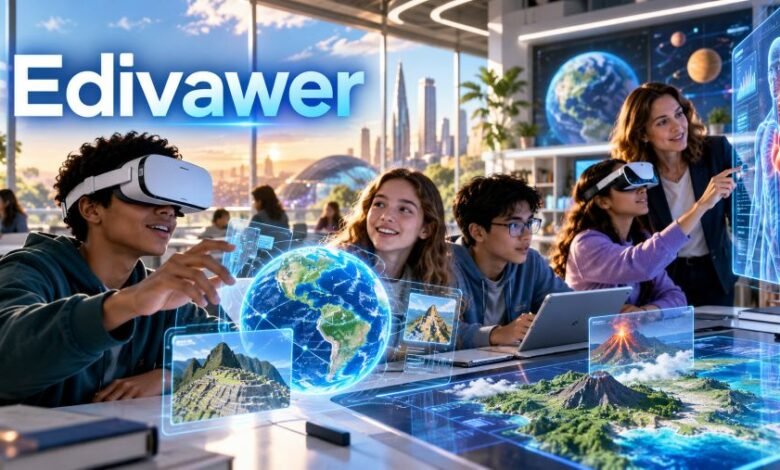
Edivawer is commonly described as an emerging concept that connects digital education with artificial intelligence, virtual reality, augmented reality, and hands-on learning experiences. Some websites call it a learning platform, while others treat it as a broader technological idea.
There is an important difference between these descriptions. Although the technologies associated with the term are real, reliable public evidence confirming Edivawer as an established commercial product remains limited.
Quick Facts
| Detail | Information |
|---|---|
| Name | Edivawer |
| Main association | Digital education and immersive learning |
| Related technologies | AI, VR, AR, wearable technology |
| Primary focus | Interactive and experience-based education |
| Potential users | Students, teachers, trainers, professionals |
| Confirmed founder | Not publicly verified |
| Official website | Not reliably established |
| Commercial availability | Unconfirmed |
| Current status | Emerging term or educational concept |
What Is Edivawer?
Edivawer is a term used online to describe an approach to digital learning where people participate in educational activities rather than simply watching videos or reading text.
Think about a student learning human anatomy.
A traditional lesson might involve a textbook illustration. An immersive lesson could allow that student to examine a three-dimensional model of the human body, rotate organs, and see how different systems work together.
That is the kind of learning experience associated with the concept.
It combines technology with practical activities to make complicated subjects easier to understand.
Still, readers should avoid confusing a proposed educational model with a verified product. Online descriptions do not establish that a single functioning system currently provides all these capabilities under this name.
Where Did the Name Come From?
The exact origin of the word is uncertain.
One interpretation appearing in online discussions connects its letters with education, digital technology, virtual reality, augmented reality, wearable devices, and experiential learning.
These ideas explain the broader direction of the concept.
Education represents teaching and learning. Digital refers to computer-based content. Virtual reality creates simulated environments, while augmented reality places digital information over real-world surroundings.
Wearable devices can provide another way to interact with educational content.
Experiential learning means gaining knowledge through activities, practice, and experience.
However, this expansion should be treated as an unofficial interpretation rather than a confirmed definition.
How Could This Learning Model Work?
The idea is fairly straightforward.
Instead of providing every student with identical lessons, an advanced educational system could offer different learning experiences according to the subject and the learner’s needs.
For example, a student studying engineering might work with a virtual machine. A medical trainee could practise a procedure in a simulated environment. Someone studying history might view a three-dimensional reconstruction of an ancient city.
An intelligent learning system could also adjust the difficulty of exercises based on earlier answers.
These are possible applications of immersive education, not confirmed features of an Edivawer product.
Learning Through Virtual Reality
Virtual reality uses computer-generated environments to create the feeling of being inside a different space.
With suitable equipment, learners can practise activities that would otherwise be expensive, difficult, or unsafe to perform repeatedly.
Flight training is one example.
Simulations allow trainees to experience situations without operating an actual aircraft during every practice session.
Using Augmented Reality
Augmented reality adds digital content to a view of the physical world.
A learner might point a compatible device toward a machine and see labels explaining its individual components.
This can help connect theoretical knowledge with physical objects.
Personalized Digital Lessons
Artificial intelligence can support educational systems by recommending exercises, generating practice questions, or helping identify areas where students need additional assistance.
Such features require careful design.
Automated feedback can make mistakes, and educational institutions still need qualified teachers to assess learning outcomes.
Practical Learning Activities
Reading about a subject and practising it are two different experiences.
Interactive activities can give learners opportunities to test their understanding, make decisions, and correct mistakes.
This approach is especially relevant to technical education, workplace training, and professional skill development.
Why Are People Searching for This Term?
Unusual technology-related keywords sometimes receive attention because different websites provide conflicting explanations.
That appears to be the case here.
Some articles describe Edivawer as educational software. Others link it to business productivity, automation, digital creativity, or an abstract branding idea.
These inconsistent descriptions make it difficult for readers to identify exactly what the name represents.
They also show why independent verification matters.
A detailed online article does not automatically establish that a product, organization, or service exists.
Before trusting a particular description, readers should check for official documentation, company details, independent demonstrations, and genuine customer information.
Possible Benefits of Immersive Digital Education
Although the status of the named platform is uncertain, the wider educational technologies connected with it have several possible advantages.
Better visual understanding: Three-dimensional models can help explain subjects that are difficult to communicate through static images.
More opportunities for practice: Simulated environments can allow repeated exercises without requiring physical equipment for every session.
Flexible access: Some digital lessons can be completed outside traditional classrooms, provided learners have the necessary devices and internet access.
Different learning approaches: Interactive systems can combine written explanations, audio, demonstrations, and practical exercises.
Training for difficult situations: Simulations can introduce learners to unusual or potentially hazardous scenarios in a controlled setting.
These benefits depend on educational quality, accessibility, implementation, and the technology being used. They should not be interpreted as proven results from Edivawer itself.
Where Could These Technologies Be Useful?
Schools and Universities
Educational institutions can use interactive models to explain science, geography, engineering, and other subjects.
A virtual laboratory, for example, may help students understand an experiment before working with physical equipment.
Professional Training
Companies can use simulated exercises to teach employees specific tasks.
Examples include safety training, equipment handling, and emergency response procedures.
Medical Education
Healthcare training may benefit from anatomy models and carefully designed simulations.
Such tools can provide additional practice, although they do not replace supervised clinical experience.
Remote Education
Digital learning tools can connect students and instructors who live in different locations.
However, immersive technology may require hardware, internet access, and technical support that are not available to everyone.
What Are the Main Limitations?
Technology alone cannot guarantee better education.
Several practical problems need attention.
Equipment such as VR headsets may be expensive. Some learners experience discomfort during extended virtual reality sessions. Teachers may require additional training, and institutions must consider accessibility for students with different needs.
Privacy is another concern.
Digital education systems can collect sensitive information about student behaviour, progress, and performance. Organizations should explain what information they collect and how they protect it.
There is also the problem of exaggerated online claims.
A website describing advanced capabilities without demonstrating a functioning product should not be treated as reliable proof that those capabilities exist.
Is It a Real Company or Software Platform?
As of October 2026, the publicly available sources reviewed do not provide sufficient independent confirmation of a widely established company or commercial learning system operating under this name.
That does not prove that nobody has ever used the name for a private project or experimental product.
It simply means that claims about an official company, founder, headquarters, user base, pricing structure, or complete software package should not be presented as confirmed facts.
Anyone considering a product advertised under this name should request direct evidence from its provider before registering or making payments.
What Does the Future Look Like?
Immersive learning has applications well beyond any single name or proposed platform.
As education providers test artificial intelligence, simulations, and mixed-reality tools, students may gain access to more interactive learning activities.
The most useful systems will be those that solve genuine educational problems.
Clear lessons, accurate information, accessible design, and meaningful feedback matter more than impressive technical descriptions.
Whether Edivawer develops into a recognized product or remains an internet term is still uncertain.
The ideas associated with it, however, point toward an ongoing conversation about how digital tools can support teaching and training.
Final Thought
Edivawer is an interesting example of how a new technology term can spread online before its identity is clearly established.
The name is often connected with immersive education, AI-assisted learning, virtual reality, and practical digital experiences. These fields offer real possibilities for schools, businesses, and individual learners.
But possibility is not the same as proof.
For now, the most accurate way to understand the term is as an emerging educational concept with limited verified information about any commercial platform behind it.
Frequently Asked Questions
1. What is Edivawer?
Edivawer is an emerging term commonly associated with digital education, interactive learning, artificial intelligence, and immersive technologies.
2. Is it a real educational platform?
A widely established commercial platform with this name has not been independently verified through the public sources reviewed.
3. What technologies are connected with the concept?
The term is commonly associated with AI, virtual reality, augmented reality, wearable devices, and experience-based learning.
4. Is it free to use?
There is no reliably verified official pricing structure, so its cost and availability cannot be confirmed.
5. Can students benefit from immersive education?
Yes. Well-designed simulations and interactive lessons may help students practise skills and understand complex topics.
6. Does it have an official mobile application?
No verified official mobile application was identified in the reviewed sources.
7. Can businesses use similar learning technologies?
Yes. Businesses can use immersive training systems for employee education, technical instruction, and simulated workplace exercises.
8. Is Edivawer safe?
There is insufficient verified information to assess the safety of a specific product using this name. Users should verify its provider, privacy practices, and legitimacy before sharing personal information.