
Donna Haraway: The Scholar Who Changed How We See Cyborgs
From biology and feminist theory to cyborgs, companion species, and ecological thinking, Donna Haraway has spent decades asking how humans live with science, technology, animals, and each other.

Introduction
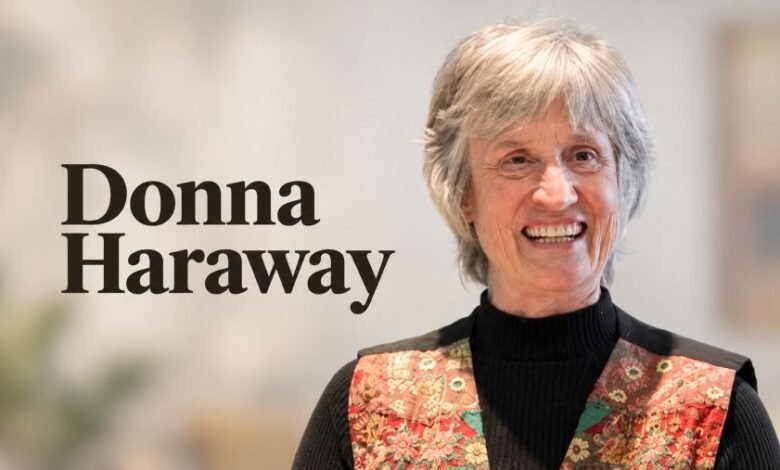
Donna Haraway is an American scholar and writer best known for “A Cyborg Manifesto.” That 1985 essay made her name far beyond university classrooms.
But her work goes much further.
She trained in biology. She studied science history. Then she built a career around questions of knowledge, technology, feminism, animals, ecology, and human responsibility.
Right now, Haraway is Distinguished Professor Emerita at the University of California, Santa Cruz.
She is still publicly active too.
In May 2026, she gave a major UCSC lecture titled “Staying with the Trouble for Still Possible Times.”
Her recent honours are big ones. She received the 2025 Erasmus Prize and the 2025 Golden Lion for Lifetime Achievement at the Venice Architecture Biennale.
Quick Facts About Donna Haraway
| Fact | Detail |
|---|---|
| Full professional name | Donna J. Haraway |
| Date of birth | September 6, 1944 |
| Birthplace | Denver, Colorado, United States |
| Nationality | American |
| Profession | Scholar, writer, feminist theorist, historian of science |
| Main academic fields | Science and technology studies, feminist theory, multispecies studies |
| Undergraduate education | Colorado College |
| Graduation year | 1966 |
| Doctoral degree | PhD in Biology |
| Doctoral university | Yale University |
| PhD year | 1972 |
| Current verified role | Distinguished Professor Emerita at UC Santa Cruz |
| Best-known work | “A Cyborg Manifesto” |
| Major later book | Staying with the Trouble |
| Major 2025 honours | Erasmus Prize and Golden Lion for Lifetime Achievement |
Who Is Donna Haraway?
Donna Haraway is one of the best-known writers in science and technology studies.
Her background is unusual.
She started with biology.
Then her work moved across science, philosophy, history, feminism, culture, technology, and relations between humans and other species.
Basically, she kept asking one question.
How do our ideas shape reality?
That includes scientific ideas.
It includes technology too.
Haraway became especially known for challenging simple divisions such as human versus machine, nature versus culture, and human versus animal.
Her writing often asks readers to stop treating those categories as completely separate.
That idea runs through decades of work.
Early Life and Education
Donna Haraway was born on September 6, 1944, in Denver, Colorado.
She later attended Colorado College.
Her studies included zoology and philosophy, with wider interests that crossed different academic areas.
She graduated in 1966.
Haraway then spent time in Paris on a Fulbright scholarship.
There, she continued studying ideas linked with evolution.
Next came Yale University.
She completed a PhD in Biology in 1972.
That detail matters.
Haraway is often discussed as a feminist theorist or cultural thinker, but her academic training came directly from science.
Her doctoral research looked at developmental biology.
More specifically, she studied how scientific metaphors could affect the way researchers thought about biological development.
Those ideas later became her first book.
Her First Book
Haraway’s first book was Crystals, Fabrics, and Fields.
It was published in 1976.
The book grew from her doctoral work.
Its subject was twentieth-century developmental biology.
But Haraway was not only describing laboratory research.
She was also looking at language.
How did scientists describe living systems?
What metaphors did they use?
And could those metaphors change the questions scientists asked?
That interest stayed with her.
Words mattered.
Scientific stories mattered too.
Early Academic Career
Haraway worked at the University of Hawaiʻi during the early 1970s.
She later joined Johns Hopkins University.
There, she worked around the history of science.
A major change came in 1980.
Haraway moved to the University of California, Santa Cruz.
She joined the History of Consciousness program.
That became her main academic home.
Her position connected feminist theory with science, culture, politics, and technology.
It also placed her inside one of the most unusual interdisciplinary academic programs in the United States.
Why “A Cyborg Manifesto” Became So Important
This is the work most people know.
Haraway published the essay commonly called “A Cyborg Manifesto” in 1985.
The cyborg in Haraway’s writing is not simply a science-fiction robot.
That misses the point.
She used the cyborg as an idea.
A cyborg mixes categories.
Human and machine.
Natural and artificial.
Body and technology.
That gave Haraway a way to question strict boundaries that people often treat as fixed.
Her cyborg argument also became closely tied to feminist theory.
She questioned the idea that identity had to fit neat, permanent boxes.
That helped the essay spread into many fields.
People read it in feminist studies.
Others read it in media studies.
Technology scholars used it too.
Artists, designers, and cultural theorists also picked it up.
The essay still follows Haraway today.
But it is only one part of her work.
“Situated Knowledges”
Another major Haraway text appeared in 1988.
Its title was “Situated Knowledges: The Science Question in Feminism and the Privilege of Partial Perspective.”
The basic idea is sharp.
Nobody sees from nowhere.
Haraway argued against the idea of completely detached knowledge.
Every observer has a position.
That does not mean facts become meaningless.
Her point was different.
Knowledge comes from somewhere.
So researchers should be clear about their standpoint, limits, methods, and responsibility.
This idea became widely discussed in feminist science studies and related fields.
Primate Visions
In 1989, Haraway published Primate Visions.
The book looked at primatology.
But again, she asked wider questions.
How had scientists represented primates?
How did ideas about gender, race, family, and nature enter those representations?
Haraway treated science as real work done by real people inside real cultures.
That approach made the book important in science studies.
It later received the Robert K. Merton Award in 1992.
Simians, Cyborgs, and Women
Haraway’s Simians, Cyborgs, and Women appeared in 1991.
It collected several essays written across earlier years.
Two became especially famous.
One was “A Cyborg Manifesto.”
The other was “Situated Knowledges.”
This book helped bring Haraway’s work to a much larger audience.
It also tied together many of her early concerns.
Science.
Bodies.
Technology.
Gender.
Knowledge.
Power.
And the stories people tell about nature.
Later Work on Science and Technology
Haraway continued writing about technoscience during the 1990s.
In 1997, she published ©Meets_OncoMouse™.
The title looks strange.
That was intentional.
The book dealt with biotechnology, scientific authority, feminism, and the language used around modern science.
It later received the Ludwik Fleck Prize.
In 2000, Haraway received the J.D. Bernal Prize for her contributions to science and technology studies.
That award recognised a much wider body of work.
From Cyborgs to Companion Species
Haraway’s later work moved strongly toward animals and multispecies life.
Dogs became especially important.
In 2003, she published The Companion Species Manifesto.
The book asked readers to think about humans and dogs as species that have shaped each other’s lives over long periods.
This was not simply a book about pets.
Haraway was asking a bigger question.
How do species become who they are through relationships?
She continued this line of thought in When Species Meet, published in 2008.
That book looked beyond dogs.
It considered human relationships with many forms of life.
The focus had shifted.
But the old question remained.
Where do boundaries really sit?
Staying with the Trouble
One of Haraway’s best-known later books is Staying with the Trouble: Making Kin in the Chthulucene, published in 2016.
Here she focused heavily on ecological damage, species relationships, and survival.
She also pushed the phrase “making kin.”
For Haraway, kinship does not have to mean only biological family.
It can mean building serious relationships and responsibilities across species and communities.
She also used the term “Chthulucene.”
The word is tied to her attempt to think about earthly life without putting humans alone at the centre.
Her language can be unusual.
Sometimes deliberately so.
But the basic point is clear.
Humans live with others.
Our choices affect them.
Their lives affect ours.
Donna Haraway’s Main Books and Works
Some of her best-known works include:
- Crystals, Fabrics, and Fields — 1976
- “A Cyborg Manifesto” — 1985
- “Situated Knowledges” — 1988
- Primate Visions — 1989
- Simians, Cyborgs, and Women — 1991
- ©Meets_OncoMouse™ — 1997
- The Companion Species Manifesto — 2003
- When Species Meet — 2008
- Manifestly Haraway — 2016
- Staying with the Trouble — 2016
These works show a long shift.
She started from biology.
Then science history.
Then cyborgs and technology.
Later came animals, ecological thought, and multispecies relationships.
Still, the thread stays visible.
Haraway keeps asking how knowledge gets made and how living beings become connected.
Awards and Honours
Haraway has received recognition from several academic and cultural fields.
Her documented honours include:
- Robert K. Merton Award in 1992
- Ludwik Fleck Prize in 1999
- J.D. Bernal Prize in 2000
- SFRA lifetime contribution award in 2011
- Wilbur L. Cross Medal from Yale in 2017
- SLSA Lifetime Achievement Award in 2019
- Golden Lion for Lifetime Achievement in 2025
- Erasmus Prize in 2025
The last two stand out.
They came decades after her best-known cyborg essay.
So her influence did not stop in the 1980s or 1990s.
It kept moving.
The 2025 Erasmus Prize
Haraway received the 2025 Erasmus Prize.
The award came from the Praemium Erasmianum Foundation.
Its 2025 theme was “the pursuit of what binds us.”
The prize included €150,000.
The official ceremony took place at the Royal Palace Amsterdam in November 2025.
The foundation highlighted Haraway’s work across science, philosophy, ecology, and human relationships with other forms of life.
Golden Lion for Lifetime Achievement
Also in 2025, Haraway received the Golden Lion for Lifetime Achievement from the Venice Architecture Biennale.
That may surprise some readers.
She is not an architect.
But her work has travelled far beyond one academic field.
Questions about human and nonhuman life, technology, environment, and collective living are also major topics in architecture and design.
The award ceremony took place in May 2025.
Donna Haraway’s Current Role
As of September 2026, Haraway is Distinguished Professor Emerita in the History of Consciousness Department at UC Santa Cruz.
Emerita means she no longer holds the same regular teaching position she once did.
But she remains active.
She continues to take part in intellectual life at UCSC.
She has links with its Science and Justice Research Center and Center for Cultural Studies.
In May 2026, she delivered the Helene Moglen Lecture.
Its title was “Staying with the Trouble for Still Possible Times.”
So, basically, her public scholarly work continues.
Donna Haraway’s Personal Life
Haraway has kept most public attention on her work.
Her husband is Rusten Hogness.
Haraway herself has referred to him publicly.
Her relationships with dogs have also appeared in her writing.
That is relevant to her academic work.
Dogs such as Cayenne became part of the thinking behind her companion-species books.
She did not treat those relationships as cute side stories.
She used them to think seriously about how humans and other animals shape each other’s lives.
Does Donna Haraway Have a Verified Net Worth?
There is no reliable public financial record that supports a specific Donna Haraway net worth figure.
So a number should not be guessed.
Generic net-worth websites are not enough.
The same applies to salary estimates.
Haraway’s academic appointments and major awards are documented, but those facts cannot be used to calculate her personal wealth.
Why Donna Haraway Still Matters
Haraway has been writing for decades.
Yet many of her questions feel current.
What happens when technology becomes part of everyday bodies?
Who gets to define scientific truth?
How should humans live with animals?
What responsibilities come with environmental damage?
And what happens when old categories stop working?
Those questions explain why people still read her.
Her cyborg writing is probably the entry point.
But it is not the whole story.
Her work kept changing.
From embryos to primates.
From cyborgs to dogs.
From technology to ecological survival.
The subject moved.
The method stayed sharp.
Final Thoughts
Donna Haraway is best known as the writer behind “A Cyborg Manifesto,” but calling her only a cyborg theorist leaves out most of her career.
She trained as a biologist.
She studied how science uses language.
She wrote about primates, technology, feminism, dogs, ecology, knowledge, and relationships across species.
Her work can be difficult.
Sometimes very difficult.
Yet the basic questions are surprisingly direct.
Who gets to know?
From what position?
And how do we live together?
As of 2026, Haraway remains connected with UC Santa Cruz as a Distinguished Professor Emerita and continues to take part in public academic work.
Her 2025 Erasmus Prize and Golden Lion also show that her ideas still travel well beyond the departments where they began.
Frequently Asked Questions
Who is Donna Haraway?
Donna Haraway is an American scholar and writer known for work on science, technology, feminism, animals, and multispecies relationships.
What is Donna Haraway famous for?
She is best known for the 1985 essay commonly called “A Cyborg Manifesto.”
When was Donna Haraway born?
She was born on September 6, 1944.
Where was Donna Haraway born?
She was born in Denver, Colorado, United States.
What did Donna Haraway study?
She studied at Colorado College and later earned a PhD in Biology from Yale University in 1972.
Where did Donna Haraway teach?
Her main academic career became closely associated with the University of California, Santa Cruz, where she joined the History of Consciousness program in 1980.
What does “A Cyborg Manifesto” discuss?
It uses the cyborg as a way to question strict boundaries involving humans, machines, nature, identity, and technology.
What is Donna Haraway’s current role?
As of September 2026, she is Distinguished Professor Emerita at UC Santa Cruz.
What is Donna Haraway’s net worth?
No specific net worth figure is supported by reliable public financial records.
What major awards has Donna Haraway received?
Her honours include the J.D. Bernal Prize, Wilbur L. Cross Medal, 2025 Erasmus Prize, and 2025 Golden Lion for Lifetime Achievement.