
Michael Grade: The Man Who Helped Change British Television
From a young newspaper journalist to a leading name at the BBC, Channel 4, ITV and Ofcom, Michael Grade has spent decades making big decisions in British broadcasting. Here is his story, including his family, education, career, wife, children and life today.

Introduction
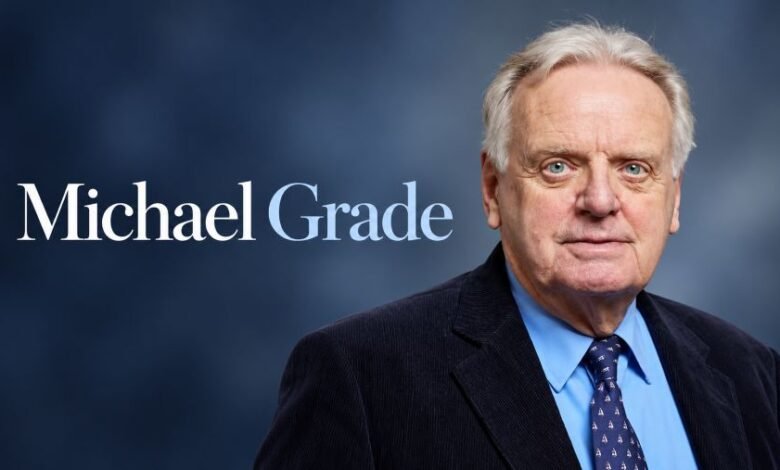
Michael Grade is a British television executive, businessman and member of the House of Lords. He is best known for leading some of the UK’s biggest broadcasting organisations, including the BBC, Channel 4 and ITV.
His career started in journalism. Then came television, where he made decisions that changed what millions of people watched. Some brought praise. Others upset viewers.
Born on 8 March 1943, he is 83 years old as of October 2026. His most recent major public appointment was as chairman of Ofcom, a position he held from 2022 until April 2026.
So, who is the man behind these well-known television decisions?
Quick Facts About Michael Grade
| Detail | Information |
|---|---|
| Full Name | Michael Ian Grade |
| Known As | Lord Grade of Yarmouth |
| Date of Birth | 8 March 1943 |
| Age | 83 years (2026) |
| Birthplace | London, England |
| Nationality | British |
| Profession | Television executive, businessman and life peer |
| Education | Stowe School and St Dunstan’s College |
| Father | Leslie Grade |
| Famous Uncles | Lew Grade and Bernard Delfont |
| Wife | Francesca Leahy |
| Previous Wives | Penelope Jane Levinson and Sarah Lawson |
| Children | Three |
| Famous For | Leadership at BBC, Channel 4, ITV and Ofcom |
| Former Ofcom Role | Chairman (2022–2026) |
| Political Affiliation | Conservative |
| Major Honour | CBE |
| Net Worth | Not publicly verified |
Early Life and Family Background
Michael Ian Grade was born in London on 8 March 1943.
Entertainment was already part of his family.
His father, Leslie Grade, worked as a theatrical agent. Two of his uncles, Lew Grade and Bernard Delfont, became famous names in British show business.
This was no ordinary family business.
Lew Grade built a successful career in television production, while Bernard Delfont became a major figure in theatre and live entertainment.
The family had roots in Eastern Europe. Earlier generations used the surname Winogradsky before establishing themselves in Britain.
Michael grew up around people who understood performers, audiences and the business behind entertainment.
But his childhood had difficult moments.
His parents separated while he was young, and his grandmother had an important part in raising him.
Those early years helped form his interest in entertainment. Still, having successful relatives did not mean he could simply walk into every job.
He had work to do.
Education and School Years
He attended Stowe School in Buckinghamshire and St Dunstan’s College in London.
Unlike many people who later reached senior business positions, Grade did not follow a university-based route into management.
He entered journalism at a young age.
That decision gave him direct experience of newspapers, readers and daily deadlines.
It was a practical education.
He learned about the media by working in it, something that would later help him understand television audiences and programme schedules.
His First Job Was in Journalism
Grade began his professional career at the Daily Mirror in 1960.
He was just 17.
Starting as a trainee journalist, he gained experience in newspaper reporting and later worked as a sports columnist between 1964 and 1966.
Journalism taught him to work quickly.
A newspaper needs fresh stories every day. Editors must understand what readers want, and they often make decisions under pressure.
Grade became familiar with that environment early.
But newspapers were only the beginning.
In 1966, he joined his family’s theatrical agency business. The move brought him closer to performers, television producers and entertainment contracts.
He later worked in talent management before joining London Weekend Television in 1973.
His career was changing direction.
Building a Career at London Weekend Television
London Weekend Television, commonly called LWT, was an important commercial television broadcaster.
Grade joined the company as deputy controller of entertainment programmes in 1973.
He later became director of programmes.
This gave him much greater responsibility.
He worked with television schedules, programme ideas and entertainment productions. He also had to consider viewing figures and budgets.
A television programme can be popular and still be expensive to make. Broadcasters must balance both sides.
Grade understood that problem.
His years at LWT helped establish his reputation as a television executive who could make commercial decisions while working closely with programme teams.
In 1981, he moved to the United States.
There, he became president of Embassy Television, giving him experience in the American entertainment industry.
Three years later, Britain called again.
Taking Charge of BBC One
In 1984, Grade became controller of BBC One.
It was a major appointment.
BBC One was already one of Britain’s best-known television channels, and its programmes reached millions of homes.
He had considerable influence over what appeared on television.
During his time in senior BBC programming roles, the channel introduced or supported several programmes that became familiar to British viewers.
These included:
- EastEnders, which began in 1985.
- Howards’ Way, which also started in 1985.
- Casualty, which launched in 1986.
- The Singing Detective, Dennis Potter’s television drama.
- Blackadder II, which returned with a changed format.
The BBC also broadcast Live Aid in 1985, a major international charity music event.
Grade’s period at the BBC showed his willingness to back ambitious programmes.
Still, he made unpopular decisions too.
One became famous among science-fiction fans.
Why Did He Upset Doctor Who Fans?
Grade’s decision about Doctor Who remains one of the most discussed parts of his BBC career.
In 1985, production of the long-running science-fiction series was put on hold.
The break lasted around 18 months.
Fans were disappointed.
Doctor Who already had a loyal audience, and many viewers strongly disagreed with the decision.
Grade had concerns about the programme’s quality and production.
His comments and decisions attracted criticism, particularly from viewers who wanted the series to continue without interruption.
The programme eventually returned.
For many Doctor Who fans, though, Grade’s name remained connected with that difficult period.
It showed something about his leadership style.
He was prepared to make decisions that might upset viewers, even when the programme had a strong following.
A New Chapter at Channel 4
Grade became chief executive of Channel 4 in 1988.
He remained in the job until 1997.
Channel 4 had a different identity from traditional mainstream broadcasters.
It was known for offering programmes that served different audiences and covered subjects other channels sometimes avoided.
Under Grade, the broadcaster continued developing that approach.
Some programmes were popular. Others attracted complaints and newspaper criticism.
He faced the challenge of keeping Channel 4 financially secure while maintaining its unusual programming identity.
The channel also supported British film production through Film on Four.
One major success was the 1994 romantic comedy Four Weddings and a Funeral.
The film became internationally successful and helped draw attention to the British film industry.
During his Channel 4 years, Grade received a BAFTA Fellowship in 1994.
By the time he left in 1997, he had become one of the country’s best-known broadcasting executives.
Business Roles Outside Broadcasting
His career was not limited to television channels.
After leaving Channel 4, Grade joined First Leisure Corporation, where he eventually became chief executive.
He later held senior positions with other major businesses.
These included Pinewood Shepperton, Camelot and Ocado.
Pinewood Shepperton was closely connected with British filmmaking and studio production.
Camelot operated the UK’s National Lottery.
Ocado became a familiar name in online grocery shopping.
The companies worked in different markets, but each required experienced business leadership.
Grade also worked with charitable and cultural organisations.
His appointments showed how his experience in broadcasting management could extend into other parts of business.
Returning to the BBC as Chairman
In May 2004, Grade returned to the BBC.
This time, he became chairman of the BBC Board of Governors.
His new position was different from running BBC One.
Rather than deciding the daily programme schedule, he helped lead the organisation’s governing body.
The BBC was dealing with questions about public trust, management and its future direction.
It was a demanding period.
Grade remained chairman until November 2006.
Then came another major career move.
He decided to leave the BBC and join ITV.
The decision attracted considerable attention because he was moving from the public broadcaster to one of its main commercial competitors.
His Time as ITV Executive Chairman
Grade joined ITV as executive chairman in January 2007.
ITV was facing strong competition in a changing television market.
Advertising income was under pressure, and broadcasters were beginning to face new viewing habits.
His job involved helping ITV respond to those commercial problems.
The company needed to control costs while maintaining programmes that attracted large audiences.
It was not an easy assignment.
Grade stepped down as executive chairman in 2009.
His ITV period added another major British broadcaster to his career record.
Very few television executives had held such senior roles across the BBC, Channel 4 and ITV.
Becoming a Member of the House of Lords
Grade entered the House of Lords in January 2011.
He received a life peerage and became Baron Grade of Yarmouth.
A life peer can take part in parliamentary work, including debates and committee investigations.
Grade initially sat as a Conservative peer.
His parliamentary work included membership of committees examining business, industry and regulation.
He also chaired the House of Lords Gambling Industry Committee from June 2019 until June 2020.
His experience in commercial broadcasting was relevant to discussions about media regulation and public policy.
In May 2022, he became a non-affiliated member while serving as Ofcom chairman.
He returned to Conservative affiliation on 1 May 2026.
Leading Ofcom from 2022 to 2026
In May 2022, Grade became chairman of Ofcom.
Ofcom is the UK’s independent communications regulator.
Its responsibilities cover television, radio, telecommunications and certain online services.
As chairman, Grade provided board-level leadership rather than managing every complaint or regulatory investigation personally.
The appointment brought him back into a major public role.
This time, he was working within the regulatory system rather than running a television broadcaster.
Ofcom’s responsibilities also grew during this period, especially following the Online Safety Act 2023.
The law gave the regulator new duties concerning online services and illegal or harmful content.
Grade completed his four-year term on 30 April 2026.
On 3 June 2026, the UK government confirmed Sir Ian Cheshire as the new Ofcom chairman.
So Grade is no longer leading Ofcom.
Who Is His Wife?
Grade has been married three times.
His first wife was Penelope Jane Levinson. They married in 1967 and divorced in 1981.
In 1982, he married Sarah Lawson, a film producer. Their marriage ended in divorce in 1991.
He married Francesca Leahy in 1998.
Francesca is his latest publicly documented wife.
Although Grade has spent much of his life in the public eye, he has generally kept many personal family matters away from regular media coverage.
That distinction matters.
His professional career is extensively documented, but the same cannot be said for every part of his home life.
Does He Have Children?
Yes. Grade has three children.
He had two children from his first marriage to Penelope Jane Levinson.
His third marriage produced a son named Samuel.
There is limited reliable public information about the children’s current private lives.
Grade is mainly known for his professional appointments, public statements and broadcasting decisions rather than his role as a parent.
Awards and Professional Recognition
Grade has received several honours during his career.
Among the most notable are:
- 1994: BAFTA Fellowship for his contribution to television.
- 1997: Harvey Lee Award from the Broadcasting Press Guild.
- 1998: Appointed Commander of the Order of the British Empire (CBE).
- 2011: Created Baron Grade of Yarmouth as a life peer.
These honours recognise different parts of his professional and public work.
The BAFTA Fellowship is especially notable because it reflects recognition from the television and entertainment industry.
His peerage later gave him a formal role in Parliament.
His Autobiography
In 1999, Grade published an autobiography titled It Seemed Like a Good Idea at the Time.
The book covers experiences from his career in journalism, television and show business.
It offers his personal account of working with well-known figures and making difficult professional decisions.
For readers interested in the history of British television, the book provides another way to understand his career.
It also gives context to a period when television executives had considerable influence over what the public watched.
How Much Is He Worth?
There is no reliable, publicly verified figure for Grade’s net worth in 2026.
He has held senior positions at well-known broadcasters and commercial companies.
But professional success does not automatically establish someone’s personal wealth.
Salary reports, company appointments and business interests do not provide a complete picture of private assets.
That means any precise current net-worth claim needs proper financial evidence.
Without it, the figure remains unknown.
What Is He Doing Now?
As of October 2026, Grade remains a member of the House of Lords.
His term as chairman of Ofcom ended in April 2026.
His parliamentary record shows that he returned to Conservative affiliation in May 2026.
He continues to have a public record connected with parliamentary work, broadcasting and regulation.
His career has covered more than six decades.
From the Daily Mirror to the House of Lords, his professional life has taken several unexpected turns.
But television remains the subject most closely connected with his name.
Final Thought
Michael Grade has had an unusual career.
He started as a teenage journalist. Later, he helped run some of Britain’s biggest television organisations.
Not every decision was popular.
His treatment of Doctor Who still attracts discussion, while his BBC and Channel 4 years are remembered for major programming changes.
His career also reached far beyond broadcasting, into business, Parliament and regulation.
Now in his eighties, he remains part of Britain’s public life.
For anyone interested in the people behind British television, his story is an important part of that history.
Frequently Asked Questions
1. Who is Michael Grade?
Michael Grade is a British television executive, businessman and life peer. He has held senior positions at BBC One, Channel 4, ITV and Ofcom.
2. How old is he in 2026?
He is 83 years old. He was born on 8 March 1943.
3. Where was he born?
He was born in London, England.
4. Who is his wife?
His latest publicly documented wife is Francesca Leahy. They married in 1998.
5. How many children does he have?
He has three children, including a son named Samuel.
6. Why is he famous?
He is known for leading major British television organisations and making important programming decisions.
7. Is he still Ofcom chairman?
No. His term ended on 30 April 2026. Sir Ian Cheshire succeeded him.
8. What is his net worth?
His current net worth has not been reliably verified through publicly available financial information.