
Paul Preston: The Historian Who Made Modern Spain His Life’s Work
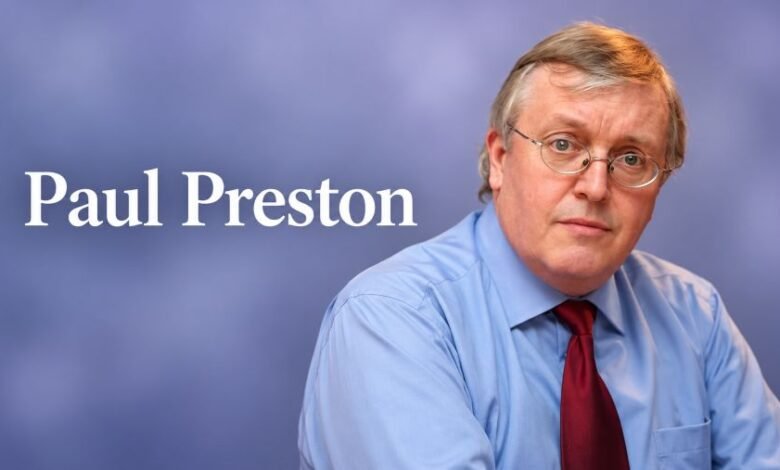
Sir Paul Preston is a British historian best known for his decades of research on Francisco Franco, the Spanish Civil War and twentieth-century Spain.

Introduction
Sir Paul Preston is a British historian and Hispanist who has spent more than five decades studying modern Spain.
His name is closely tied to the Spanish Civil War.
That is the main reason.
Born in Liverpool in 1946, Preston went from a working-class upbringing to Oxford and later became one of the best-known British scholars working on Spanish history.
His books cover Francisco Franco, the Second Spanish Republic, political violence, Spain’s move towards democracy and Britain’s relationship with Spain.
As of September 2026, the London School of Economics still lists Professor Sir Paul Preston as a School Professor in its Department of International History.
Quick Facts About Paul Preston
| Fact | Detail |
|---|---|
| Full name | Sir Paul Preston CBE |
| Born | 1946 |
| Birthplace | Liverpool, England |
| Profession | Historian and Hispanist |
| Main field | Modern Spanish history |
| University | London School of Economics |
| Joined LSE | 1991 |
| British Academy Fellow | Since 1994 |
| Major honour | Knight Bachelor |
| Knighthood | 2018 |
| Main subjects | Spanish Civil War, Franco era, modern Spain |
| Recent original book | Perfidious Albion (2024) |
Early Life in Liverpool
Paul Preston was born in Liverpool in 1946.
His childhood came soon after war.
That mattered.
Preston has spoken publicly about growing up around memories of wartime Liverpool. Adults still talked about the Blitz, while damaged areas of the city remained part of everyday surroundings.
His early interest was history.
Spain came later.
Preston has said that he did not study Spanish at school. His first strong interest centred more on the Second World War and twentieth-century Europe.
His route into Spanish history developed during his academic years.
Education at Oxford and Reading
Preston won a scholarship to Oxford.
He studied at Oriel College.
After his undergraduate studies, he attended the University of Reading and completed an MA in European Studies.
He then returned to Oriel College for doctoral research.
Institutional records from Universitat Rovira i Virgili list his degree in 1968, his master’s qualification in 1969 and his doctorate in 1975.
That academic work set his direction.
Spain became the focus.
His doctoral research later provided the base for his early book-length work on the breakdown of democracy before the Spanish Civil War.
Paul Preston’s Early Academic Career
Preston started teaching at the University of Reading in 1973.
He stayed there until 1975.
Then came Queen Mary College.
He spent many years there and eventually became Professor of Contemporary History.
He also served as Dean of the Faculty of Arts from 1985 to 1991.
That period built his academic standing.
His research kept returning to Spain.
By then, Preston was writing about subjects that would follow him through the rest of his career: political division, Francoism, democracy and the Spanish Civil War.
Joining the London School of Economics
A major career move came in 1991.
Preston joined the London School of Economics as Professor of International History.
LSE became his main academic home.
Three years later, in 1994, he became director of the Cañada Blanch Centre for Contemporary Spanish Studies.
He remained director until 2020.
That is a long run.
The centre became closely linked with research on Spain, Spanish politics and Anglo-Spanish relations.
As of September 2026, LSE continues to list Preston among its academic staff as a School Professor in International History.
Some university material also describes him as an emeritus professor.
Both descriptions appear in current institutional material.
His Work on the Spanish Civil War
The Spanish Civil War sits at the centre of Preston’s work.
He has returned to it again and again.
His writing looks at politics, war, repression, journalism, ideology and the people caught inside the conflict.
One of his best-known books is The Spanish Civil War: Reaction, Revolution and Revenge.
He also wrote We Saw Spain Die, which looks at foreign correspondents who covered the war.
Then came The Spanish Holocaust.
Published in English in 2012, the book examines mass killing and political repression linked to the war and the Franco era.
The subject is heavy.
Preston treated it as historical research rather than simply military history.
That approach helped push attention towards victims, political violence and remembrance.
Paul Preston and Francisco Franco
Francisco Franco is another major subject in Preston’s career.
His large study Franco: A Biography became one of his best-known books.
It was first published in the 1990s and has remained closely associated with his name.
The work looks at Franco’s rise, dictatorship and place in Spanish history.
Preston continued speaking and writing about Franco decades after the book appeared.
In November 2025, he gave a major interview to El País during the period marking 50 years since Franco’s death.
So this is not old research left behind.
He still works with the subject.
A graphic edition based on his Franco work, created with illustrator José Pablo García, was published in 2025.
Major Books by Paul Preston
Preston has written a long list of books on Spain.
Some stand out more.
The Coming of the Spanish Civil War
This work grew from his doctoral research and examined the political and social pressures that came before the conflict.
Franco
His major study of Francisco Franco became one of the defining books of his career.
The Triumph of Democracy in Spain
This book looks at Spain’s political development after Franco and the move towards democratic government.
Comrades!
Published in 1999, Comrades! Portraits from the Spanish Civil War uses individual lives to tell parts of the larger story.
Doves of War
This book focuses on four women connected with the Spanish Civil War and its political setting.
Juan Carlos: A People’s King
Preston wrote about King Juan Carlos and later revised the work as new events changed the public picture around the former monarch.
We Saw Spain Die
The book focuses on foreign journalists who covered the Spanish Civil War.
The Spanish Holocaust
This work studies political violence, killing and repression during the Civil War and Franco period.
The Last Stalinist
Published in 2014, the book examines Spanish Communist leader Santiago Carrillo.
The Last Days of the Spanish Republic
This book looks at the closing stage of Republican Spain during the final months of the Civil War.
A People Betrayed
Published in 2020, this study looks at corruption, political failure and social division across modern Spanish history.
Architects of Terror
Published in English in 2023, the book examines conspiracy thinking, antisemitism and political fear inside Francoist Spain.
Perfidious Albion
Published in 2024, Perfidious Albion: Britain and the Spanish Civil War looks at British connections with the conflict.
It discusses government policy, medical aid, writers and people who shaped British understanding of events in Spain.
Awards and Honours
Preston has received honours in Britain and Spain.
That reflects the two-country nature of his career.
He became a Fellow of the Royal Historical Society in 1982.
Spain awarded him the Encomienda de la Orden del Mérito Civil in 1986.
He was elected a Fellow of the British Academy in 1994.
In 2000, he was appointed Commander of the Order of the British Empire, or CBE.
He later received the Grand Cross of the Order of Isabella the Catholic in 2007.
Then came a British knighthood.
In 2018, Preston was appointed a Knight Bachelor for services to UK-Spain relations.
He has also received honorary doctorates from several universities, including institutions in Britain and Spain.
His Work Beyond Books
Preston’s work has not stayed inside libraries.
He has taken part in talks, interviews and public discussions about Spanish history.
He is also the founding chair of the International Brigade Memorial Trust.
The organisation works to keep alive the history of people connected with the International Brigades during the Spanish Civil War.
His historical archive also has a Spanish home.
An agreement was made for Preston’s documentary collection to be deposited at the Monastery of Poblet in Catalonia, with university involvement.
That gives researchers another way to use material gathered across his career.
What Is Paul Preston Doing Now?
As of September 2026, Preston remains listed by LSE as a School Professor in International History.
His research interests still include the Spanish Civil War, Franco, European fascism, Spain’s democratic transition and Anglo-Spanish relations.
He also continues appearing in public historical discussions.
In 2025, for example, he took part in events and interviews looking at the continuing historical debate around Francoism and Spanish democracy.
His latest confirmed original book in the research reviewed here is Perfidious Albion, published in 2024.
A graphic edition linked to his Franco work followed in 2025.
Why Paul Preston Is Known
The answer is pretty clear.
Paul Preston is known because he made modern Spanish history the centre of a very long academic career.
His work reaches across civil war, dictatorship and democracy.
He has written about political leaders.
But he has also written about journalists, women, victims, activists and ordinary people caught inside major events.
That wider view is one reason his books appear far beyond university reading lists.
His career also connects Britain and Spain in a rare way.
He was born and educated in Britain.
Yet much of his life’s research has focused on Spain.
The honours he received from both countries reflect that link.
Final Thought
Paul Preston’s story is mainly about scholarship.
Not celebrity.
He started in post-war Liverpool, studied at Oxford and Reading, taught at Queen Mary and then built a long career at the London School of Economics.
Spain became his main subject.
He kept returning to its hardest periods.
The Civil War. Franco. Political violence. Democracy.
Those themes shaped decades of writing.
As of 2026, Preston remains connected with LSE and continues to be recognised for his work on twentieth-century Spain.
Frequently Asked Questions
Who is Paul Preston?
Paul Preston is a British historian best known for his research and books on the Spanish Civil War, Francisco Franco and modern Spain.
When was Paul Preston born?
He was born in Liverpool in 1946.
What does Paul Preston do?
He is a historian and academic whose main research field is modern Spanish history.
Where does Paul Preston work?
As of September 2026, LSE lists him as a School Professor in its Department of International History.
What is Paul Preston best known for?
He is best known for major books on Franco, the Spanish Civil War, political repression and Spain’s move towards democracy.
Is Paul Preston a professor?
Yes. LSE lists Professor Sir Paul Preston as a School Professor in International History.
Why was Paul Preston knighted?
He was knighted in 2018 for services to UK-Spain relations.
What is Paul Preston’s latest book?
His latest confirmed original book identified in the research is Perfidious Albion: Britain and the Spanish Civil War, published in 2024.