
Viltnemnda: What It Is and How Norway Manages Wildlife
From injured animals and road accidents to hunting rules and conservation, discover how Norway's local wildlife committees help protect animals and communities.

Introduction
Norway is home to remarkable wildlife. Moose roam through forests, deer move across rural roads, and wild animals share large areas of land with people. Managing these animals is not always easy, especially when wildlife comes into contact with farms, vehicles, or residential areas.
This is where Viltnemnda comes in.
Viltnemnda is a Norwegian term for a local wildlife committee or board. It is associated with municipal wildlife management, including hunting administration, injured animals, conservation, and wildlife-related problems.
But there is something important to understand. Not every Norwegian municipality has a separate committee called Viltnemnda. Some handle these responsibilities through other local government departments.
Quick Facts About Norway’s Wildlife Committee
| Detail | Information |
|---|---|
| Name | Viltnemnda |
| Country | Norway |
| English meaning | Wildlife Committee or Wildlife Board |
| Main purpose | Local wildlife management |
| Administrative level | Municipal |
| Main activities | Wildlife management, hunting matters, injured animals |
| Animals involved | Moose, deer, and other wildlife |
| Responsible public authority | Municipality |
| Road accident reporting | Norwegian Police |
| Police non-emergency number | 02800 |
| Main modern legislation | Wildlife Resources Act (Viltressursloven) |
| New law effective | 1 July 2026 |
What Is Viltnemnda?
Viltnemnda is a Norwegian local government committee responsible for certain wildlife matters in municipalities where such a committee exists.
The word has two parts:
- Vilt: Wild animals or game.
- Nemnd: A committee or board.
Together, the term means a committee dealing with wildlife affairs.
The committee is not simply an animal rescue organisation. Its work concerns public wildlife administration, which may involve balancing animal welfare, hunting, ecological concerns, and public safety.
For example, a municipality may need to decide how local deer populations should be managed or arrange assistance when a moose is injured in a road accident.
A wildlife committee can support these responsibilities within the authority assigned to it by the municipality.
How Did the System Begin?
Wildlife management has long been part of Norwegian public administration.
Historically, local wildlife committees operated within the framework established by Norway’s wildlife legislation.
A significant change came in 1993.
Responsibility for local wildlife administration was transferred to municipalities, which were then able to choose how to organise that work.
Some municipalities continued using elected wildlife committees. Others moved responsibilities into different administrative departments.
This explains why wildlife management arrangements can vary between Norwegian towns and districts.
Hamar Municipality, for example, describes its own wildlife and fisheries committee and the historical development of local wildlife boards.
The system also experienced a major legal change in 2026. Norway’s Wildlife Resources Act, known as Viltressursloven, came into force on 1 July 2026, replacing the 1981 Wildlife Act.
The newer legislation continues to recognise municipal responsibilities for wildlife management.
What Does a Local Wildlife Committee Do?
The exact duties depend on local arrangements and powers delegated by the municipality.
However, several types of work are commonly associated with these committees.
Managing Wild Animal Populations
Wild animal populations change over time.
If deer numbers rise substantially in a particular area, this may create additional pressure on vegetation, farmland, and road safety.
Local wildlife authorities need reliable information before recommending management measures.
Their work can involve monitoring populations, reviewing local conditions, and contributing to decisions about sustainable hunting.
The purpose is not necessarily to increase or decrease every wildlife population.
It is to support responsible management based on the situation in each area.
Helping With Injured Wildlife
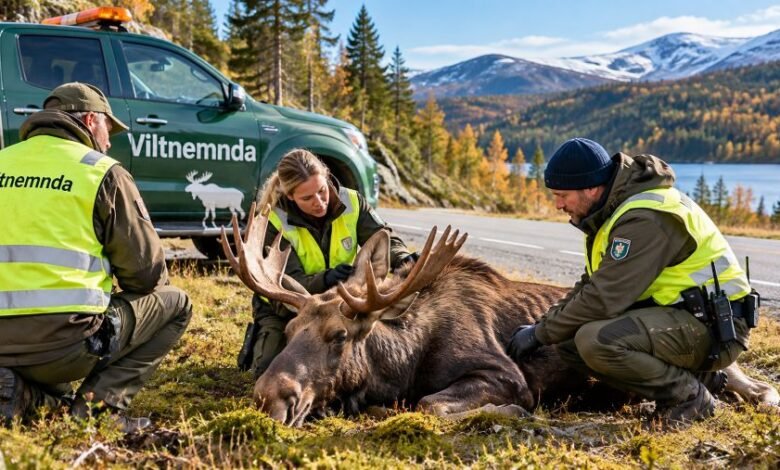
A moose can survive a vehicle collision but still suffer serious injuries.
Sometimes an injured animal escapes into a forest, making its condition difficult to assess.
Municipal wildlife personnel or designated search teams may become involved in locating and assessing such animals.
Specially trained people can investigate injuries and take lawful action when necessary.
The main concern is to avoid unnecessary animal suffering while protecting public safety.
Supporting Hunting Administration
Hunting is a long-established activity in Norway.
Yet hunting is not an activity that can take place without rules.
Local authorities may have responsibilities relating to hunting areas, management plans, population assessments, and allocations for certain game species.
Wildlife committees can contribute to these decisions where the municipality has given them the relevant authority.
Their involvement helps connect local environmental knowledge with the country’s hunting regulations.
Addressing Wildlife-Related Problems
Wild animals sometimes cause problems near homes or agricultural land.
Deer may damage crops. Large animals can appear on busy roads. Wildlife may also create concerns around public spaces.
A local committee or wildlife department may help evaluate the situation and determine which public authority should respond.
Not every animal sighting requires intervention.
In many situations, allowing the animal to move away without disturbance is the safest option.
What Happens When a Car Hits a Wild Animal in Norway?
Wildlife collisions are among the most practical reasons people encounter the term Viltnemnda.
Imagine driving along a rural Norwegian road at dusk.
A moose suddenly steps onto the road. The driver brakes, but the vehicle strikes the animal.
The moose then disappears into the trees.
Even if the animal is no longer visible, the incident must be reported.
According to the Norwegian Public Roads Administration, failing to report an animal collision can be an offence.
Here is what drivers should do:
- Stop safely and assess the situation.
- Turn on hazard warning lights and wear a reflective vest.
- Secure the accident scene with a warning triangle when safe.
- Call the police on 02800 to report the collision.
- Provide the location, animal description, and direction in which it travelled.
- Follow police instructions about marking the location.
- Do not chase the injured animal or attempt to euthanise it without proper authorisation.
The police can notify the appropriate wildlife committee, municipal personnel, or other responsible responders.
If someone is seriously injured, contact the medical emergency service on 113. For an immediate police emergency, call 112.
A quick report can prevent an injured animal from suffering without assistance.
Why Are Moose and Deer Important?
Norway’s large herbivores are closely connected to forest and mountain ecosystems.
Moose, known in Norwegian as elg, are particularly recognisable.
They can weigh hundreds of kilograms, making collisions dangerous for motorists.
Deer and other grazing animals also influence vegetation and the wider environment.
These animals have ecological, cultural, and recreational importance.
However, different species need different management approaches.
A plan that works for a local moose population may not be suitable for wild reindeer living across a large mountain region.
This is why wildlife management requires local information and coordination between authorities.
Who Appoints the Committee Members?
Where municipalities maintain an elected wildlife committee, members may be appointed by the municipal council.
The committee’s structure is determined by local arrangements.
Stange Municipality, for example, has regulations describing the election of committee members and substitutes by its municipal council.
Members may bring knowledge of hunting, forestry, agriculture, local environmental conditions, or wildlife administration.
Their decisions and responsibilities are still subject to the applicable laws and the authority delegated to them.
There is no single committee structure that applies identically to every Norwegian municipality.
How Does the Committee Work With Other Authorities?
Local wildlife management does not operate separately from the rest of Norwegian government.
Different authorities have responsibilities at different levels.
| Authority | General role |
|---|---|
| National ministries | Wildlife legislation and national policy |
| National directorates | Administrative guidance and assigned regulatory responsibilities |
| County Governor (Statsforvalteren) | Oversight and certain administrative appeals |
| Municipality | Local wildlife management |
| Local wildlife committee | Delegated municipal wildlife responsibilities |
| Police | Incident reporting and public safety response |
These bodies may cooperate depending on the issue.
For example, a road accident involving a deer may begin with a police report before the municipal wildlife response becomes involved.
A hunting management decision, on the other hand, may follow a different administrative process.
Is Viltnemnda the Same as Villreinnemnda?
No. The terms are related but refer to different bodies.
Viltnemnda generally refers to a local wildlife committee connected with municipal administration.
Villreinnemnda refers to a wild reindeer management board.
Wild reindeer often move through areas extending across municipal boundaries, so their management requires a wider geographic approach.
A wild reindeer board has responsibilities specifically connected with managing wild reindeer populations and their habitats.
The two names can look similar to readers unfamiliar with Norwegian, but they should not be treated as interchangeable.
Why Does Local Wildlife Management Matter?
Wildlife conservation and human activities frequently meet in the same places.
Consider a community surrounded by forests.
Residents want safe roads. Farmers want to protect crops. Hunters need clear regulations. At the same time, animals need suitable habitats.
These interests do not always point in the same direction.
A local wildlife body can bring area-specific knowledge into the decision-making process.
Three broad benefits stand out.
Better public safety: Local authorities can respond to wildlife incidents and help organise injured-animal searches.
More informed management: Decisions about hunting and population numbers can take account of local conditions.
Greater public accountability: Wildlife matters can be considered through municipal processes rather than informal arrangements alone.
Good management also requires accurate records, trained personnel, and cooperation between local and national authorities.
How Can You Contact Your Local Wildlife Authority?
There is no single national Viltnemnda office serving every municipality in Norway.
For ordinary questions, start with the official website of the municipality where the matter occurred.
Search for Norwegian terms such as viltforvaltning, viltnemnd, or fallvilt.
These can help you find information about the local wildlife department, committee, or injured-animal service.
For animal collisions on roads, however, use the police reporting number rather than spending time searching for a committee contact.
This allows the appropriate authorities to coordinate the response.
What Changed Under Norway’s 2026 Wildlife Law?
On 1 July 2026, Norway introduced the Wildlife Resources Act.
The legislation replaced the older Wildlife Act of 1981 and updated the legal framework for hunting, capture, killing, and wildlife administration.
Although the new law preserved much of the previous legal approach, it clarified several rules and was accompanied by changes to regulations.
Section 7 addresses the responsibilities of counties and municipalities in wildlife management, including their role in providing advice and guidance.
For residents, hunters, and landowners, this means it is important to consult current legislation rather than relying only on older references to the 1981 law.
Municipal committees may continue operating, but their specific powers must reflect the current legal framework and local delegation decisions.
Common Misunderstandings
One common misunderstanding is that Viltnemnda is a nationwide rescue agency.
It is not.
The term usually describes a local wildlife committee, while the municipality holds the underlying public responsibilities.
Another misconception is that committee members can independently decide any wildlife matter.
Their authority is limited by law and by what has been delegated to them.
A third misunderstanding is that an animal must be killed after being struck by a vehicle.
That is not automatically the case.
Qualified personnel must assess the situation and determine the appropriate response.
These distinctions matter because wildlife cases can involve legal responsibility, animal welfare, and serious safety risks.
Final Thought
Viltnemnda represents an important part of Norway’s approach to local wildlife management.
Although its organisation differs between municipalities, the idea remains straightforward: local wildlife matters need informed decisions, legal oversight, and practical cooperation.
From hunting administration to injured animals and road incidents, municipal wildlife services help communities respond to situations where people and wild animals come into contact.
Understanding the system also helps residents and visitors know whom to contact when something goes wrong.
For drivers, the most important point is simple. Report animal collisions promptly so trained personnel can respond.
Frequently Asked Questions
1. What does Viltnemnda mean in English?
Viltnemnda means wildlife committee or wildlife board. It is a Norwegian term used for a local body associated with municipal wildlife management.
2. Is there a wildlife committee in every Norwegian municipality?
No. All municipalities have relevant wildlife responsibilities, but not all maintain a separate committee called Viltnemnda.
3. What animals does the committee deal with?
Its responsibilities can involve moose, deer, and other wildlife, depending on local conditions, applicable regulations, and delegated authority.
4. What should I do if I hit a deer in Norway?
Stop safely, secure the accident scene, and report the collision to the police on 02800. The police can contact the relevant wildlife responders.
5. Can committee members decide hunting quotas?
A committee may contribute to or make certain hunting-related decisions where the municipality has delegated legal authority. The exact responsibilities vary.
6. Who appoints the members?
In municipalities with an elected wildlife committee, members are generally appointed through local government arrangements, often by the municipal council.
7. Is Viltnemnda a private organisation?
No. It refers to a public committee associated with local municipal wildlife management rather than a private charity or company.
8. What law governs wildlife management in Norway in 2026?
The Wildlife Resources Act, which came into force on 1 July 2026, provides an important part of the current legal framework alongside other applicable laws and regulations.