

Kouskousi Explained: The Tiny Greek Pasta With a Big Story
What this traditional Greek food is, how it differs from couscous, where it comes from, and the best ways to cook and serve it.

Introduction
Kouskousi may look like couscous at first glance. The name sounds almost identical too. That is exactly why so much confusing information about this food appears online.
In Greek, κουσκούσι — pronounced roughly “kouskousi” — is defined as a type of pasta made in small grain-like pieces. Greece’s official tourism website also lists couscous-style kouskousi among the traditional pasta products associated with Soufli, a town in the Evros region of Thrace.
So, despite the familiar-looking name, it should not automatically be treated as ordinary instant couscous.
Quick Facts About Kouskousi
| Fact | Detail |
|---|---|
| Food type | Small grain-shaped pasta |
| Greek name | κουσκούσι |
| Strong regional link | Thrace, Greece |
| Notable location | Soufli, Evros |
| Appearance | Tiny grains or bead-like pasta |
| Main use | Soups, broths and pasta dishes |
| Similar-looking food | North African couscous |
| Cooking rule | Check the package because preparation can vary |
What Is Kouskousi?
Kouskousi is a small pasta traditionally found in Greek cooking.
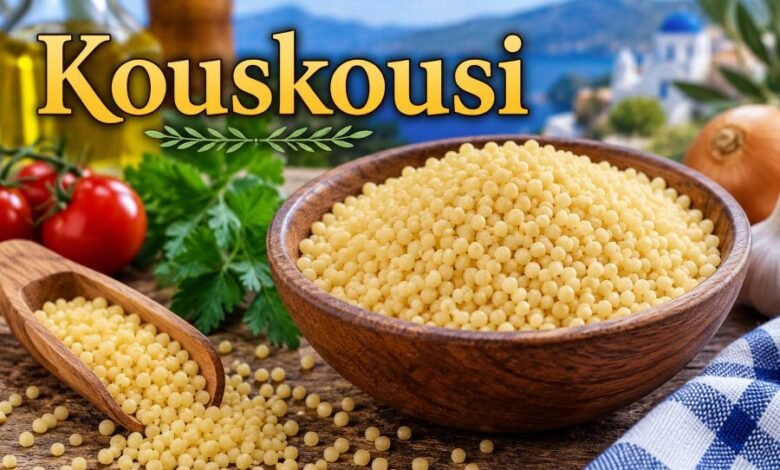
Rather than having long strands like spaghetti or flat pieces like lasagne, it appears as many tiny grains. This shape can easily make someone think they are looking at couscous.
There is good linguistic evidence for the term.
The Dictionary of Standard Modern Greek records κουσκούσι (kouskousi) and defines it as a type of granular pasta. The dictionary connects the word with Turkish kuskus, which itself has Arabic roots.
That definition matters because online articles sometimes describe the term only as another spelling of North African couscous.
The real picture is more nuanced.
Where Does Kouskousi Come From?
One of the clearest regional links is Thrace in northeastern Greece.
Visit Greece, the official Greek tourism portal, specifically mentions kouskousi while describing the local food traditions of Soufli. It places it alongside other traditional pasta products such as trachanas, handmade phyllo sheets and oumats.
Soufli lies in Evros, close to Greece’s borders with Turkey and Bulgaria. Its cuisine reflects a long regional history in which ingredients, names and cooking customs have crossed communities and borders.
That background also helps explain why the word resembles kuskus and couscous so closely.
There is no reliable evidence pointing to one individual who invented the pasta or one exact year when it first appeared. It is better understood as part of a regional food tradition rather than a modern commercial invention.
Is Kouskousi the Same as Couscous?
Not necessarily.
This is the most important distinction for anyone searching the term.
Traditional North African couscous has a very well-documented preparation method. UNESCO describes semolina being rolled by hand, steamed and then cooked. The associated knowledge and practices of Algeria, Mauritania, Morocco and Tunisia were added to UNESCO’s Representative List of the Intangible Cultural Heritage of Humanity in 2020.
Greek kouskousi, meanwhile, is documented as a granular pasta.
They can look surprisingly similar.
They can even have related names.
But that does not mean every product carrying one of those names should be prepared in exactly the same way.
Kouskousi vs Couscous
| Kouskousi | Traditional Couscous |
|---|---|
| Greek granular pasta | North African semolina food |
| Often treated like pasta | Traditionally rolled and steamed |
| Associated with Greek regional cooking | Strongly associated with the Maghreb |
| May be cooked directly in liquid | Traditionally steamed |
| Tiny grain-like shape | Tiny semolina granules |
The safest rule is simple: read the cooking instructions on the packet.
If it is sold as Greek pasta, prepare it according to the pasta manufacturer’s directions rather than assuming instant-couscous instructions will work.
What Does Kouskousi Look Like?
Tiny.
That is its defining visual feature.
The pieces resemble coarse grains or miniature pasta beads. Depending on how it has been produced, their size and shape may not be perfectly identical.
This small shape makes the pasta useful in meals where larger noodles would feel too heavy.
It can sit naturally inside broth, catch sauces and spread evenly through vegetable or meat dishes.
Its appearance is also the main reason it gets confused with other foods.
Someone seeing an unlabelled bowl might mistake it for couscous, pastina or another tiny pasta variety.
What Does It Taste Like?
The pasta itself has a relatively mild flavour.
Much of the final taste comes from whatever surrounds it — broth, tomato, vegetables, herbs, meat juices or sauce.
That is actually one of its strengths.
A neutral base can take on the character of a dish without overpowering the other ingredients.
Cook it in a rich broth and it becomes savoury.
Pair it with tomato and herbs and the result changes completely.
Serve it simply and the wheat flavour is more noticeable.
How to Cook Kouskousi
Cooking instructions can differ according to the producer and the exact product, so the packet should always come first.
For a pasta-style version, the basic method is straightforward.
Bring water or broth to a boil. Add the pasta and stir so that the small pieces do not gather together. Cook until they reach the texture you want, then drain if necessary.
Broth works especially well because the tiny pieces absorb flavour while cooking.
Watch the texture closely.
Very small pasta can move from pleasantly tender to overly soft faster than larger shapes. It can also continue absorbing liquid after the heat has been switched off.
If you are adding it directly to soup, remember that the soup may become thicker as the pasta cooks.
Easy Ways to Serve It
Kouskousi works with simple food.
That makes it useful.
You can add it to a vegetable soup, cook it in chicken broth, serve it beside a meat dish or mix it with a tomato-based sauce.
A few practical combinations include:
- chicken broth with herbs and vegetables
- tomato sauce with garlic and onion
- roasted vegetables with small pasta
- beef or lamb stew
- mushroom broth
- simple pasta salad with fresh vegetables
- warm bowls with chickpeas and herbs
There is no need to make the dish overly complicated.
Because the pieces are small, strong sauces and heavily textured ingredients can sometimes hide them. A balanced broth or lighter sauce lets the pasta keep its own character.
Why Soufli Matters to the Story
Soufli gives the term a clear geographic anchor.
The town is widely known for silk production, but its food culture also forms an important part of its identity.
The official Visit Greece description of the area names traditional pasta among the local products and specifically mentions “couscous-style kouskousi.” It places the food within the broader rural cuisine of the Evros region.
That description is especially useful because it avoids two extremes.
It does not claim the Greek food has no connection at all with couscous.
But it also does not erase its place within Greek pasta traditions.
The resemblance is real. So is the regional distinction.
Why Is the Name So Confusing Online?
Several things are happening at once.
First, the spellings are extremely similar: couscous, kuskus, kouskous and kouskousi.
Second, the foods themselves can look alike.
Third, cultures around the Mediterranean have interacted for centuries. Food names often cross linguistic boundaries and change slightly in pronunciation or spelling.
Finally, many newer web pages simply repeat claims from other websites without checking a dictionary, cultural institution or official regional source.
That can quickly turn an uncertain statement into something that looks established.
In this case, the Greek-language dictionary offers useful clarity: κουσκούσι is documented as granular pasta.
Meanwhile, UNESCO provides separate documentation for the traditional production and consumption of North African couscous.
Both traditions can be discussed without pretending they are identical.
Is Kouskousi a Grain?
It looks like one.
It is better classified as pasta in the Greek usage documented by the dictionary.
Tiny pasta shapes often create this confusion because individual pieces can resemble rice, wheat kernels or other grains.
The difference comes from how the food is produced.
A natural cereal grain grows in that form. Pasta is manufactured from processed wheat ingredients and shaped before drying or cooking.
So when you see Greek kouskousi described as a grain, check whether the writer is talking about its appearance rather than its actual food category.
Does Kouskousi Contain Gluten?
Traditional wheat-based pasta contains gluten.
People with coeliac disease, wheat allergy or another medical reason for avoiding gluten should therefore not assume that this food is safe simply because the pieces resemble rice or another grain.
Always read the ingredient and allergen information on the specific package.
Recipes and commercial products can vary.
The label is more reliable than appearance.
How Should It Be Stored?
Dry pasta is easy to keep.
Store an unopened or opened dry product in a cool, dry place, preferably inside a sealed container once the original packet has been opened.
Keep moisture out.
Cooked pasta belongs in the refrigerator and should be handled according to normal food-safety guidance.
One practical point is worth remembering: the small pieces can continue absorbing liquid after cooking.
Soup containing the pasta may therefore become noticeably thicker after refrigeration.
Adding a little extra broth during reheating can restore the consistency.
Why Kouskousi Is Still Relevant Today
There is something appealing about tiny regional foods.
They rarely need flashy presentation.
They survive because people cook them.
In Soufli and the wider Thracian food tradition, pasta products remain part of the area’s gastronomic identity. Greece’s official tourism material highlights these foods alongside local meats, drinks, preserves and other products maintained by small producers and cooperatives.
At the same time, wider interest in Mediterranean cooking has introduced more people to regional pasta shapes that once rarely appeared outside their home areas.
That makes this small pasta much easier to understand — and much harder to dismiss as simply a misspelling of couscous.
Final Thought
Kouskousi is a good example of why food names need context.
The Greek term κουσκούσι is documented as a small granular pasta, and official Greek tourism information connects couscous-style kouskousi with the traditional foods of Soufli in Thrace.
Its similarity to North African couscous is impossible to miss, yet the cooking traditions should not automatically be treated as interchangeable.
If you have a packet in front of you, check the ingredients and cooking directions.
That tiny detail solves most of the confusion.
FAQs About Kouskousi
What is Kouskousi?
Kouskousi is a Greek term for a small grain-shaped pasta. Greece’s official tourism site also identifies couscous-style kouskousi as a traditional pasta product associated with Soufli in Thrace.
Is Kouskousi the same as couscous?
Not always. Greek sources document it as pasta, while traditional North African couscous is made from semolina that is rolled and traditionally steamed.
Where is Kouskousi from?
It has a documented connection with Greek food culture, particularly Soufli in the Evros region of Thrace.
Is Kouskousi pasta or rice?
In the Greek dictionary definition, it is a type of pasta in small grain-like pieces. It can resemble rice or grain because of its size.
How do you cook Kouskousi?
Pasta-style versions are generally cooked in liquid until tender. Exact cooking times and liquid requirements can vary, so follow the directions printed on the product you purchased.
Can Kouskousi be used in soup?
Yes. Its tiny shape makes it well suited to broths and soups. Remember that it absorbs liquid while cooking, so the dish may thicken.
Is Kouskousi gluten-free?
A wheat-based version is not gluten-free. Always check the ingredient and allergen label because formulations can vary between products.
Why does Kouskousi look like couscous?
Both can appear as very small wheat-based pieces, and their names are linguistically similar. Their regional traditions and preparation methods, however, are not necessarily the same.