

Healthcare Strategy Software for Employers: A Smarter Way to Manage Employee Benefits
Discover how modern healthcare planning platforms help businesses understand medical spending, control benefits costs, support employee wellbeing, and make better decisions in 2026.

Introduction
Healthcare costs keep rising. For employers, that creates a difficult question: how can a business provide good medical benefits without spending more than it can afford?
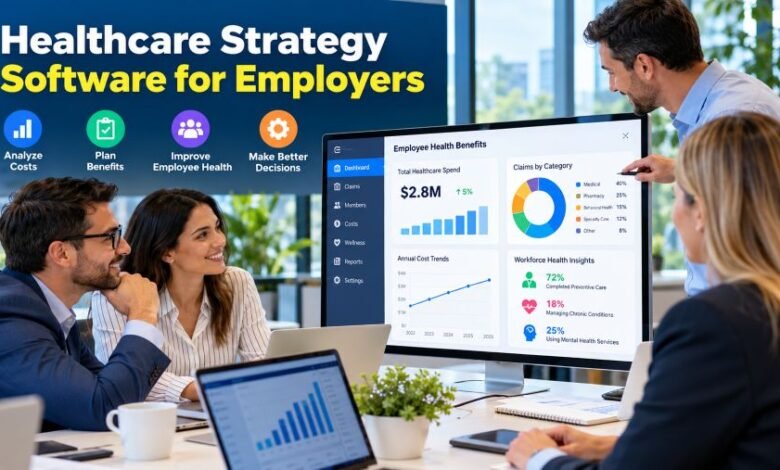
Healthcare strategy software for employers helps answer that question. Instead of relying on spreadsheets, scattered insurance reports, and guesswork, companies can use specialised platforms to understand health benefit costs, identify spending patterns, and plan better coverage for their workforce.
And the need is growing. According to the 2026 KFF Employer Health Benefits Survey, average annual premiums for employer-sponsored family coverage reached $28,303, an increase of 5% compared with 2025.
The right software cannot eliminate these costs. It can, however, help employers understand where their money goes and what changes might improve the value of their benefits.
Quick Facts
| Feature | Details |
|---|---|
| Software category | Employer healthcare strategy and benefits management |
| Main purpose | Support healthcare planning and spending decisions |
| Primary users | HR teams, benefits managers, finance leaders, employers |
| Core functions | Claims analytics, cost forecasting, benefits evaluation |
| Common data sources | Insurance claims, pharmacy data, eligibility records |
| Suitable businesses | Mid-sized companies, large organisations, self-funded employers |
| Main advantages | Better cost visibility, informed planning, performance measurement |
| Pricing | Depends on provider, workforce size, and services |
| Key consideration | Employee data security and privacy |
| Related solutions | Springbuk, Artemis Health, Personify Health |
What Is Healthcare Strategy Software?
Healthcare strategy software is a digital system that helps employers analyse, plan, and manage employee healthcare benefits.
Think of it as a decision-support tool for workplace health coverage.
An organisation might offer medical insurance, prescription drug benefits, mental health services, and preventive care. Each program has a cost, and understanding whether those programs are meeting employee needs can be surprisingly difficult.
A healthcare strategy platform brings relevant information together so decision-makers can examine spending, compare options, and evaluate results.
Depending on the product, it may help employers:
- Analyse healthcare claims and medical spending.
- Identify changes in prescription drug costs.
- Forecast future benefits expenses.
- Compare health plan designs.
- Understand common health needs across employee populations.
- Evaluate wellness and disease-management programs.
- Prepare reports for senior management.
Not every product provides all these functions. Some focus on financial analytics, while others specialise in health plan administration, care navigation, or employee engagement.
Why Businesses Are Investing in Better Benefits Planning
Employee health coverage is one of the larger operating expenses for many organisations.
The challenge goes beyond premium increases. Employers also face changing workforce needs, expensive specialty medications, different provider networks, and the administrative work involved in managing several benefits vendors.
In 2026, KFF reported that 71% of covered workers were enrolled in self-funded health plans. Under these arrangements, employers carry direct financial responsibility for covered claims, making good cost information especially valuable.
Rising Medical Expenses
Hospitals, medications, specialist appointments, and complex treatments can all affect health plan spending.
Without proper analysis, benefits teams may struggle to understand whether increased expenditure comes from higher treatment prices, more frequent use of services, or changes in employee health needs.
A suitable analytics platform can separate these factors and help teams investigate them.
Changing Employee Expectations
Employees want benefits that are affordable, understandable, and useful.
Some may need access to mental health support. Others may care more about family coverage, specialist treatment, or affordable prescriptions.
Employers need to understand these needs without improperly accessing individual medical information.
Too Many Separate Systems
Large employers may work with insurance carriers, pharmacy benefit managers, brokers, and wellness providers.
Each partner can produce its own reports. Comparing those reports manually takes time and may create inconsistent results.
A shared analytics system can make reporting easier when the necessary integrations are available.
Important Features to Look For
The best platform is not necessarily the one with the longest feature list. It is the one that answers the employer’s most important questions.
1. Healthcare Cost Analytics
Cost analytics helps businesses understand where healthcare spending is concentrated.
For example, a benefits manager might discover that pharmacy expenditure is growing more quickly than medical expenditure.
That finding provides a starting point for reviewing medication coverage, vendor contracts, and possible support programs.
Good reporting should distinguish between employee contributions, employer spending, claims costs, and administrative fees.
2. Predictive Cost Forecasting
Historical claims reveal what happened. Forecasting helps employers consider what might happen next.
Certain platforms use statistical models to estimate future spending based on previous costs, utilisation patterns, and other available data.
These estimates can help with annual budgeting and renewal negotiations.
However, predictions are not guarantees. Unexpected illnesses, changing medical prices, and shifts in employee enrollment can affect actual costs.
3. Workforce Health Analysis
Employers need to understand broad health trends across their covered populations.
Aggregated analysis may reveal opportunities to support preventive care, chronic condition management, or employee health education.
For instance, a company may find that preventive screening use is lower than expected.
It could then improve communications or make preventive appointments easier to access.
The goal should be better support, not identifying employees for employment-related decisions based on medical conditions.
4. Benefits Program Evaluation
Businesses sometimes pay for several health services without knowing which ones are being used or producing useful results.
Strategy software can help compare program participation, expenditure, and measurable outcomes.
A company could review whether its care-navigation service is helping employees access suitable providers, or whether a diabetes management program is reaching eligible members.
Careful evaluation should consider service quality and patient outcomes alongside financial results.
5. Custom Reports and Dashboards
Different departments need different information.
HR leaders may want benefits participation reports, while finance teams may need spending forecasts and budget comparisons.
Good software lets each team access relevant information without exposing unnecessary sensitive records.
6. Security and Access Controls
Healthcare information requires careful handling.
In the United States, HIPAA protections can apply to protected health information held by an employer-sponsored group health plan or its business associates.
That does not mean every employee health record held by an employer automatically falls under HIPAA. The legal requirements depend on the circumstances.
Employers should examine access permissions, encryption, audit logs, vendor contracts, and the separation between health plan administration and employment decisions.
How These Platforms Work
Although individual products differ, a typical implementation follows a straightforward process.
Step 1: Collect the data
The platform receives authorised information from health plans, claims administrators, pharmacy providers, and other relevant systems.
Step 2: Prepare the information
Data is checked, organised, and matched across sources where permitted. Duplicate records, inconsistent formats, and missing values may need attention.
Step 3: Analyse spending
The software examines claims trends, utilisation, cost categories, and changes over time.
Step 4: Identify opportunities
Benefits leaders review possible actions, such as modifying plan designs, examining provider networks, or improving employee access to preventive services.
Step 5: Implement changes
Employers work with their brokers, administrators, and healthcare vendors to introduce approved changes.
Step 6: Measure the results
Teams monitor spending, participation, employee experience, and health-related outcomes to determine whether the changes delivered value.
This final stage matters. A report is useful, but acting on it and checking the results is what makes it part of a healthcare strategy.
Examples of Software Available in 2026
Several established companies provide solutions for different parts of the employer healthcare planning process.
| Platform | Main focus | Suitable use |
|---|---|---|
| Springbuk | Health data analytics and intelligence | Identifying cost trends and benefits opportunities |
| Artemis Health | Benefits data analytics | Comparing data sources and evaluating benefits programs |
| Personify Health | Health benefits, navigation, and wellbeing | Supporting employees and managing connected health services |
| Aon Health Network Analyzer | Provider network decision support | Comparing network cost, quality, and access |
Springbuk
Springbuk offers health analytics for employers and benefits advisors.
Its software supports claims analysis, financial reporting, and the identification of health-related spending patterns.
It also combines analytics with strategic guidance to help organisations evaluate healthcare programs.
Artemis Health
Artemis Health focuses on employee benefits data analysis.
Its platform can combine medical claims, prescription data, eligibility records, and other benefits information.
Employers can use these capabilities to review costs, compare results, and assess existing programs.
Personify Health
Personify Health provides employer solutions covering wellbeing, benefits navigation, care and condition management, and certain health plan administration services.
Its approach includes helping employees understand their coverage and find appropriate care.
This makes it relevant for organisations seeking both employer-side benefits services and employee-facing support.
Aon Health Network Analyzer
Introduced in May 2026, Aon’s Health Network Analyzer helps U.S. employers compare healthcare network options using cost, quality, and access information.
It is more specialised than a general benefits management platform.
For employers reviewing network strategies, that narrower focus may be useful.
These are examples, not a ranking. Product availability, integration requirements, and included services should be checked directly with each provider.
Benefits for Employers and Employees
The software can provide value on both sides of the workplace healthcare relationship.
| For employers | For employees |
|---|---|
| Clearer spending information | Better-informed benefit choices |
| Improved budget planning | Potentially more useful coverage |
| Easier program evaluation | Better access to relevant services |
| Better vendor comparisons | More effective health support |
| More consistent reporting | Potential improvements in affordability |
However, these benefits depend on the quality of the data, the software selected, and the actions taken.
Buying a platform alone does not guarantee lower medical spending or better employee health.
How Much Does It Cost?
There is no single standard price for healthcare strategy software.
Many specialist providers use custom enterprise pricing rather than publishing a fixed monthly subscription.
Costs may depend on:
- Number of employees or covered members.
- Number and complexity of data integrations.
- Analytics modules and reporting requirements.
- Implementation and onboarding services.
- Clinical consulting or strategic support.
- Contract duration and customer support arrangements.
Some services may charge per employee or member, while others use negotiated platform or service fees.
Employers should request a complete quotation that separates setup costs, recurring charges, optional services, and data-related expenses.
A cheaper subscription is not automatically the better choice if important integrations or support services cost extra.
Choosing the Right Platform
Before selecting a provider, employers should identify the business problem they actually want to solve.
An organisation struggling with medical claims reporting has different requirements from one trying to improve employees’ ability to find care.
Understand Your Main Goal
Decide whether the priority is cost forecasting, program evaluation, benefits administration, or employee engagement.
A clearly defined objective makes vendor comparisons easier.
Check Data Compatibility
Ask whether the platform can work with your insurance carrier, third-party administrator, pharmacy benefit manager, and existing HR systems.
Also confirm who is responsible for obtaining and transferring the data.
Review Privacy Protections
Understand which users can access individual-level records and which receive only aggregated information.
For U.S. employers, HIPAA obligations, applicable state laws, and other employee privacy requirements deserve proper legal review.
Request a Demonstration
Use realistic business questions during product demonstrations.
For example, ask a vendor to show how an employer could identify changing pharmacy costs over two years.
The response will reveal more than a long sales presentation.
Measure Total Value
Compare the full cost of ownership with the benefits the system is expected to provide.
Consider reporting time saved, decision quality, better program oversight, and any measurable financial improvements.
Common Challenges During Implementation
Even strong software can produce disappointing results when the underlying processes are weak.
Incomplete data: Missing or delayed claims files can produce misleading reports.
Difficult integrations: Connecting multiple vendors can require technical work and cooperation.
Limited internal expertise: HR teams may need training to interpret advanced analysis correctly.
Privacy risks: Broad data access or weak governance can create serious compliance problems.
Unrealistic expectations: Healthcare expenses will not necessarily decrease simply because an employer has better reports.
A practical response is to begin with a limited set of goals, verify data accuracy, train the relevant users, and expand the project once the initial reporting is dependable.
What Is Changing in 2026 and Beyond?
Employer healthcare planning is becoming more closely connected with data analysis and financial decision-making.
One area receiving attention is AI-assisted analysis. Certain vendors now provide automated recommendations or forecasting capabilities that help benefits teams review large datasets.
Another is provider network evaluation. Employers increasingly want to compare costs, access to care, and quality rather than looking only at premium quotations.
Prescription drug management is also an important topic, particularly as businesses assess spending on specialty medicines and newer treatments.
There is also growing interest in connected benefits systems that combine administration, reporting, and employee support.
Still, employers should remain cautious about automated recommendations. Healthcare decisions involve uncertainty, personal information, and sometimes competing priorities between cost and access to treatment.
Human review remains necessary.
Final Thought
Healthcare strategy software gives employers a clearer picture of their health benefits spending and the decisions behind it.
That matters when budgets are tight and employees depend on affordable medical coverage.
The strongest approach is not simply to collect more data. It is to ask better questions, select suitable programs, respect employee privacy, and measure what actually changes.
For employers planning their future benefits, the right platform can become a useful part of responsible healthcare management.
Frequently Asked Questions
1. What is healthcare strategy software for employers?
It is software that helps businesses analyse employee healthcare costs, evaluate benefits programs, plan spending, and make informed health coverage decisions.
2. Can it reduce employee healthcare costs?
It may help identify opportunities for savings, such as inefficient spending or unsuitable benefit designs. However, savings depend on the actions taken and are not guaranteed.
3. Is this software suitable for small businesses?
Some solutions can support smaller employers, but advanced claims analytics are often more relevant to organisations with sufficient data and larger benefits budgets. Small businesses may find broker-supported reporting or simpler benefits platforms more practical.
4. What is the difference between benefits administration and healthcare strategy software?
Benefits administration software handles operational tasks such as enrollment, eligibility, and plan management. Healthcare strategy software focuses more on analysing costs, forecasting, comparing options, and measuring outcomes. Some platforms offer both.
5. Does the software use artificial intelligence?
Some products use AI or machine learning for predictive analysis, pattern detection, or automated recommendations. Other products rely mainly on conventional reporting and statistical tools.
6. Is employee healthcare information safe?
It depends on the provider’s security practices and how the employer uses the system. Organisations should verify access controls, data protection measures, contracts, and applicable legal requirements before sharing sensitive information.
7. How can an employer choose the best platform?
Start with clear business needs, then compare data integrations, security, reporting capabilities, vendor support, pricing, and practical demonstrations using realistic examples.
8. What are some examples of employer healthcare platforms?
Springbuk, Artemis Health, and Personify Health offer services relevant to employer benefits management and analytics. Aon also offers specialised network analysis capabilities. Their functions are different, so employers should compare them according to their needs.