

SEO by HighSoftware99.com vs Traditional SEO: Which Approach Works Better?
Discover how HighSoftware99's search visibility services compare with established SEO methods, including content strategy, Google Autocomplete, website rankings, costs, and long-term results.

Introduction
SEO isn’t what it was ten years ago. Search engines have become better at understanding what people want, businesses face tougher competition, and simply repeating keywords across a webpage is no longer a sensible growth strategy.
That is where the discussion around SEO by HighSoftware99.com vs Traditional SEO comes in.
HighSoftware99 promotes search visibility services, including Google Autocomplete placement. Other websites publishing under the HighSoftware99 name describe semantic content planning, technical improvements, and structured website architecture.
But is this genuinely different from traditional SEO? And, more importantly, which approach makes sense for a business trying to attract customers?
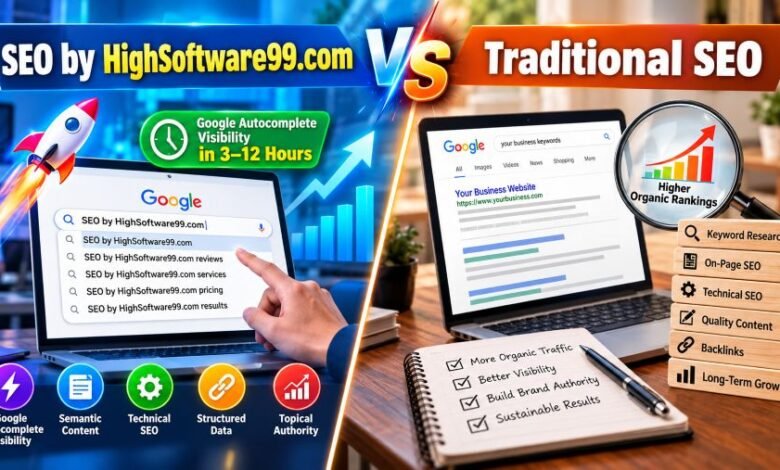
The short answer: HighSoftware99’s advertised services combine familiar SEO techniques with a particular focus on search suggestions and structured content. Established modern SEO covers many of the same technical and content practices. The biggest difference is the emphasis on Google Autocomplete, not an entirely new way of ranking websites.
Quick Facts
| Feature | Details |
|---|---|
| Main topic | SEO strategy comparison |
| Branded service | HighSoftware99 |
| Traditional approach | Organic search engine optimization |
| Main branded distinction | Google Autocomplete visibility promotion |
| Other advertised services | Technical SEO, content, backlinks, local SEO |
| Primary goal | Greater search visibility |
| Guaranteed rankings? | No independently established guarantee |
| Best decision factor | Measurable business results |
What Is SEO by HighSoftware99.com?
SEO by HighSoftware99.com refers to SEO and search visibility services promoted under the HighSoftware99 name.
The website HighSoftware99.com has advertised a service focused on getting selected terms into Google’s Autocomplete suggestions. Its published marketing material claims that some keywords can appear within 3–12 hours.
That is a striking promise.
However, appearing as a suggested query is not the same as placing a website at the top of Google’s organic search results.
Separately, a website using the name SEO by HighSoftware99 presents a broader methodology involving semantic content, entity mapping, internal links, technical improvements, and structured data.
These descriptions should be understood as the websites’ own claims. Public marketing material alone does not establish how reliably the services work or whether the different websites have the same ownership.
Main Techniques Associated With the Brand
The published descriptions focus on several activities:
- Improving a website’s technical structure and accessibility.
- Organizing content around related subjects and search intent.
- Creating internal links between useful pages.
- Applying relevant structured data.
- Building off-page visibility and backlinks.
- Promoting terms through Google Autocomplete services.
Most of these activities are already familiar to experienced SEO professionals.
The Autocomplete service is the more distinctive advertised feature.
How Does Traditional SEO Work?
Traditional SEO is the established practice of improving a website so search engines can find, understand, and present its pages to relevant users.
It includes technical maintenance, content development, keyword research, internal links, external reputation, and performance monitoring.
Some older SEO campaigns relied heavily on exact-match keyword repetition, low-quality directory links, and large quantities of thin content.
Those tactics are not a fair description of good SEO today.
Modern SEO professionals work with search intent, topical relevance, helpful information, page experience, and technical accessibility.
Google’s SEO Starter Guide recommends clear site organization, useful original content, descriptive page titles, and links that help search engines discover pages.
The Main Components
Keyword research: Identifying the searches that potential visitors or customers make.
On-page SEO: Improving titles, headings, descriptions, page structure, and internal links.
Technical SEO: Checking indexability, mobile compatibility, rendering, canonical URLs, and website performance.
Content development: Publishing original information that answers real questions.
Off-page SEO: Earning relevant mentions and trustworthy links from other websites.
Performance analysis: Using search and business data to understand what is working.
A proper SEO campaign is rarely just one activity. The parts work together.
Key Differences Between the Two Approaches
The comparison becomes clearer when the branded service is separated from established industry practices.
| Factor | HighSoftware99’s advertised approach | Established modern SEO |
|---|---|---|
| Primary emphasis | Search visibility, including Autocomplete | Organic rankings and qualified traffic |
| Keywords | Semantic content and selected visibility terms | Search intent and relevant queries |
| Website content | Entity-based topic organization | Helpful, original, topic-focused content |
| Technical work | Specific performance and structure targets | Technical audits and performance improvements |
| Backlinks | Contextual link acquisition | Relevant, editorially earned links |
| Autocomplete | Specifically promoted as a service | Usually not a central SEO deliverable |
| Measurement | Depends on the purchased service | Rankings, clicks, leads, conversions |
| Long-term value | Depends on sustained results | Built through ongoing website improvements |
There is considerable overlap.
A strategy isn’t automatically better because it carries a newer name. The quality of the work and the outcomes matter far more.
Why Google Autocomplete Is Such an Important Difference
Imagine someone opens Google and starts typing the name of a service.
Before they finish, Google displays several suggested searches.
That feature is called Google Autocomplete.
It helps users complete searches and discover possible queries. Google’s systems consider factors such as real search activity, location, language, trends, and previous searches.
The HighSoftware99 service specifically markets visibility within these suggestions.
That can sound attractive, especially to a business that wants more brand recognition.
Yet there is a catch.
Search Suggestions Are Not Search Rankings
Suppose a company name appears in Google’s suggested searches.
That does not automatically mean:
- Its website ranks first for the suggested query.
- People will click its website.
- The suggestion appears for every user.
- The business will receive more customers.
- The visibility will remain unchanged.
Autocomplete predictions can differ by location and search context.
A website could appear in a suggestion while its actual webpage ranks much lower for the completed search.
Businesses should assess these results separately.
If an agency sells Autocomplete visibility, ask for evidence of the exact suggestions, locations, devices, observation dates, and resulting business value.
Content Quality: Which Strategy Has the Advantage?
Content remains central to organic search.
A webpage needs to answer the reader’s question. Clear explanations, firsthand knowledge, accurate details, and useful examples are more important than repeating the same phrase.
The semantic approach described by HighSoftware99 places particular emphasis on relationships between topics.
For example, a website selling electric bicycles could create useful pages about battery care, charging costs, maintenance, safety, and choosing an appropriate model.
These pages cover related customer needs.
Relevant internal links can help visitors move between them.
But there is nothing exclusive about this strategy.
Modern SEO teams also use content clusters, internal linking plans, and topic research. HighSoftware99’s terminology may differ, but the underlying principles are familiar.
Which is better? Neither label guarantees stronger content. The better strategy is the one that produces accurate, useful information for a defined audience.
Technical Performance and Website Structure
Some pages never perform well because search engines struggle to access them.
Other pages are accessible but provide a frustrating experience to visitors.
Technical SEO addresses these problems.
The HighSoftware99-branded methodology website publishes ambitious technical targets, including fast server response times, low layout shift, and a limited number of page elements.
Those may be useful internal engineering targets, but they should not be mistaken for universal Google ranking requirements.
For example, Google’s Core Web Vitals assess user experience, but hitting a perfect technical score does not guarantee higher rankings.
Both established SEO specialists and providers using proprietary methods can improve:
- Website loading performance.
- Mobile usability.
- Crawlability and indexing.
- Redirects and broken links.
- Canonical URL configuration.
- Structured data accuracy.
- Internal navigation.
Here, the distinction is about execution and measurable improvements, not the name of the method.
Link Building and Online Authority
Backlinks still deserve attention.
A relevant link from a respected publication can introduce readers to a business and help search engines discover its content.
But not every backlink is worth having.
Low-quality link networks, automated link creation, and paid links intended to manipulate rankings can violate Google’s spam policies.
A provider might offer contextual links as part of its services. That description alone doesn’t prove that the links are safe or effective.
Before buying an SEO package, ask where links will appear, why those websites are relevant, and how sponsorship or payment will be disclosed.
A small number of genuinely useful editorial links may offer more business value than a huge collection of links from unrelated websites.
Which Method Produces Faster Results?
Speed is an understandable concern.
Businesses want to see progress, particularly when they are paying monthly fees.
HighSoftware99’s published Autocomplete promotion claims visibility within hours. That is a vendor claim about a search suggestion feature, not verified evidence of rapid organic ranking growth.
Traditional SEO normally involves work that develops over time. Technical fixes can be implemented quickly, while stronger organic visibility may take considerably longer.
The timeline depends on competition, site history, content quality, technical conditions, and the searches being targeted.
There is no universal deadline.
A new website competing with established national brands will face different challenges from a local business targeting a specific town.
Fast Visibility Versus Sustainable Traffic
Speed matters, but it needs context.
An SEO campaign should not be judged only by how quickly a keyword appears somewhere on Google.
A more useful question is whether the work brings relevant visitors who take meaningful actions.
Those actions might include a product purchase, booking, phone call, email enquiry, or qualified lead.
A suggestion appearing in a search box can be measured as a visibility event. It should not be counted as equivalent to an organic search click or conversion.
What About Pricing and Overall Value?
Comparing costs can be difficult because SEO packages often cover different amounts of work.
One provider may charge for a technical audit and a small number of content updates.
Another may include ongoing content production, website maintenance, reporting, and outreach.
Autocomplete visibility may be sold as a separate deliverable.
As a result, comparing two monthly prices without examining the scope can be misleading.
Before making a payment, obtain a written proposal that explains the following:
- Exactly which services are included.
- Which pages and search queries will be targeted.
- Whether Autocomplete is a separate deliverable.
- How results will be verified.
- Who owns the created content and accounts.
- What happens when the contract ends.
- Which costs are recurring or non-refundable.
This makes it easier to compare providers on actual value rather than promotional language.
Benefits and Limitations
Potential Benefits of the Branded Offering
HighSoftware99’s advertised services may interest businesses that specifically want to investigate Google Autocomplete visibility.
Its semantic SEO messaging also places attention on content organization, technical quality, and topical relationships.
These are reasonable areas for website improvement when the work is done well.
Limitations Worth Considering
Autocomplete visibility is not a substitute for organic rankings.
Published promises do not confirm achieved results. Publicly verifiable case studies, transparent methods, and reporting should carry more weight than marketing statements.
Some branded technical targets may be stricter than necessary for particular websites.
And businesses should establish exactly which provider and website they are dealing with before signing an agreement.
Advantages of Established SEO
Modern SEO has established measurement tools, documented guidelines, and a broad range of qualified professionals.
It also supports several business goals at once, including local discovery, information searches, product visibility, and lead generation.
Its main drawback is that meaningful results can require sustained work, investment, and periodic revisions.
How to Choose the Right Strategy for Your Website
Start with your business objective.
If you operate a local service company, you probably need strong service pages, accurate business information, relevant local visibility, and a clear way for customers to contact you.
If you own an online store, your priorities may involve category pages, product information, technical indexing, and conversion performance.
For a publishing website, original reporting, topic expertise, strong site structure, and reader satisfaction may be the main concerns.
A business considering Autocomplete services should first decide whether search suggestion visibility has a clear commercial purpose.
Then evaluate the evidence.
Questions to Ask an SEO Provider
A credible provider should be able to explain its process without relying on mysterious ranking secrets.
Ask for examples of completed work, anonymized performance reports where appropriate, and a realistic assessment of your website.
Request access to your own Google Search Console information.
Agree on meaningful performance indicators, such as organic search clicks, qualified enquiries, and revenue.
Also ask what methods the provider avoids.
Google warns that no SEO company can guarantee a number-one organic ranking. Anyone claiming special access to Google’s ranking systems deserves close scrutiny.
How to Measure Whether a Campaign Is Working
The best evaluation happens after clear baseline measurements have been established.
Use Google Search Console to monitor impressions, organic clicks, search queries, and indexing issues.
Use an analytics platform to assess engagement and conversions.
If Autocomplete visibility is part of the contract, measure it separately with documented searches across the agreed markets.
A practical report should distinguish between:
Visibility metrics: Search impressions, keyword positions, and observed Autocomplete suggestions.
Traffic metrics: Organic search clicks, relevant landing-page visits, and visitor engagement.
Business metrics: Leads, bookings, transactions, or other valuable outcomes.
This prevents a campaign from appearing successful based on a single impressive-looking screenshot.
Final Thought
SEO by HighSoftware99.com vs Traditional SEO is not really a contest between a completely new search system and an outdated one.
HighSoftware99 markets a distinctive Autocomplete visibility service alongside techniques already used across the SEO industry.
Modern traditional SEO also considers search intent, structured content, technical health, and genuine website authority.
For most businesses, the stronger starting point is an established, transparent SEO strategy based on useful content, sound technical work, and measurable organic results.
A specialized visibility service may have a place in a broader marketing campaign. But its value should be demonstrated, not assumed.
Choose evidence over promises. A clear strategy that attracts the right customers is worth more than a ranking claim without meaningful business results.
Frequently Asked Questions
1. What is SEO by HighSoftware99.com?
It refers to search visibility services promoted under the HighSoftware99 name, including Google Autocomplete promotion and broader SEO methods described on related branded websites.
2. Is it better than traditional SEO?
There is not enough independent performance evidence to conclude that it consistently outperforms established SEO. Many of the advertised technical and content methods overlap with current industry practices.
3. Can it make a website rank in Google within hours?
Its published rapid-visibility promotion concerns Autocomplete suggestions. That does not establish that a website can achieve top organic rankings within the same period.
4. Is Google Autocomplete the same as an organic search result?
No. Autocomplete predicts queries while someone types. Organic search results are the webpages shown after a search is submitted.
5. Does traditional SEO still work in 2026?
Yes. Technical accessibility, useful information, relevant links, and good website organization remain important parts of search visibility.
6. Is the HighSoftware99 method approved by Google?
There is no verified evidence that it is a Google-endorsed or officially recognized SEO framework. Google publishes its own guidance for website owners and SEO providers.
7. Which method is best for a small business?
A modern SEO plan built around relevant local or industry searches is usually the stronger foundation. Any additional visibility service should be assessed against clear business goals.
8. How can I check whether an SEO company is trustworthy?
Ask for verifiable case studies, a written scope of work, transparent reporting, realistic expectations, and an explanation of how the company follows search engine policies.