

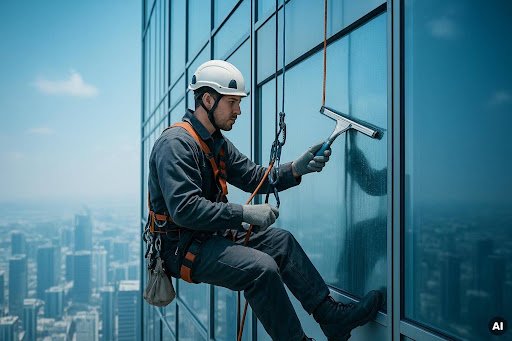
Rope access window cleaning keeps commercial buildings clean by placing trained technicians directly beside the façade with flexible, two-rope suspension systems. This close access lets them remove traffic film, mineral deposits, air pollution, and biological growth from glass, frames, and recessed building parts that automated washers, ground-based poles, and large mechanical platforms cannot reach. By cleaning the outside of the building by hand, rope access workers restore clear glass, improve the building’s appearance, and help protect exterior materials from long-term damage.
Modern commercial buildings often feature bold shapes, large overhangs, deep curtain-wall recesses, and wide glass elevations. Although these designs look impressive, they collect air pollution, engine fumes, dust, and rainwater marks that soon make the outside look dull. For property managers who need dependable façade care, professional rope access window cleaning by RAIL provides a precise cleaning service without the space limits and high ground costs linked to heavy machinery.
Industrial abseiling does more than polish glass for a better first impression. It also supports exterior safety checks and building upkeep. By keeping glass clear and checking structural parts during regular cleaning, rope access window cleaning protects the appearance and working performance of commercial properties.
What Is Rope Access Window Cleaning?
Rope access window cleaning, also called industrial abseiling in the commercial sector, is a work-positioning method based on techniques used in rock climbing and cave exploration. It has been adapted for high-level industrial maintenance. Certified technicians hang from strong synthetic ropes fixed to secure roof-level anchors or plant room structures. This allows them to move up, down, and across the outside of a building with great freedom.
Instead of using mechanical cradles, hydraulic boom lifts, or temporary scaffolding, rope technicians work with two separate ropes. One is the working line and the other is an independent safety line. This arrangement gives workers wide access across unusual building shapes while meeting strict safety rules used around the world.
How Rope Access Gives Cleaners Access to High-Rise Windows
Traditional access methods often have trouble with tall buildings. Scaffolding can take a long time to put up, while mobile elevating work platforms (MEWPs), such as cherry pickers, need a large, level area and often struggle to reach above 10 to 12 storeys. Rope access systems are fixed to approved anchor points at the top of the building, allowing technicians to descend down almost any façade, whether the tower is 15 or 50 storeys high.
Technicians use special descenders, climbing devices, chest harnesses, and positioning seats, also called bosun’s chairs, to move sideways and up or down the building face. They can use intermediate deviation anchors, suction cups, and tension lines to hold their position against vertical, sloping, or upside-down curtain walls. This range of movement lets them reach all areas of the glazing, including cantilevered upper floors and narrow inner lightwells.
Why Commercial Buildings Need Specialist Window Cleaning
Commercial glass collects far more than normal household dust. It is exposed to nitrogen oxides, tiny brake dust particles, airborne hydrocarbons, acid rain, bird droppings, and industrial chemical residue. Strong sunlight can bake these substances onto the glass. If they remain there, they may cause permanent marks in the glass, lasting mineral deposits, and faster damage to silicone weather seals.
Dirt on the outside of a building can also affect how it performs inside. Studies show that heavy façade dirt can reduce natural daylight entering a building by more than 25 percent. In commercial properties where lighting and related cooling needs account for more than 40 percent of energy use, dirty glass increases the need for electric lighting and raises energy costs. Specialist cleaning brings back more natural light, which can support staff comfort and lower energy use.
How Rope Access Window Cleaning Keeps Commercial Buildings Looking Clean
Rope access often gives better cleaning results than ground-based or automated methods because the technician can work directly beside the façade. While suspended on ropes, the technician sits only inches from the glass. They can inspect, scrub, detail, and check every part of the surface as they work.
This hands-on method lets technicians change the pressure of their tools and the amount of cleaning solution immediately, based on the type of dirt present. This helps leave each glass panel clear and free from streaks.
Removes Dirt, Dust, Hard-Water Marks, and Pollutants
Rain carries air pollution down commercial façades, where it collects on sills and around the edges of windows. When the water dries, it leaves hard-water marks, calcite streaks, and mineral scale. Standard automatic washing systems often rinse over these deposits without breaking the bond that holds them to the glass.
Rope access specialists remove these layers with spot treatments, glass-safe abrasives, and de-ionised pure water systems. They loosen baked-on dirt with non-abrasive pads before using professional squeegees to remove grease, diesel fumes, and mineral scale. This process removes the grime instead of simply spreading water across it.
Reaches Glass, Frames, Corners, and Recessed Areas
Modern buildings often move away from flat, even curtain walls. They may include decorative louvres, brise-soleil shading blades, deeply recessed window frames, and projecting steel mullions. Permanent building maintenance units (BMUs) and automatic washing systems are usually made for flat, open vertical sections. They may leave recesses and narrow corners untouched.
Rope access technicians have a wide range of movement, so they can reach into window reveals, remove debris from frame drainage holes, and clean behind solar fins. They use angle adapters, detailing microfibres, and hand tools to clean rubber gaskets and corner joints. This removes the black runoff marks that can stain freshly cleaned glass after the next period of rain.
Maintains a Consistent Appearance Across the Façade
Uneven cleaning can quickly harm a commercial building’s appearance, especially when only the lower or easiest-to-reach sections look clean. Ground-level water-fed poles may not give a clear finish above the fifth floor, while cherry pickers may be unable to reach full elevations because of basements, pavement weight limits, or nearby landscaping.
Rope access allows workers to treat the whole building exterior as one surface. Technicians can descend from every drop line around the building, including inner atriums, angled façades, and rear courtyards. The result is a consistent finish from the top-floor offices to the street-level entrance. A clean, even appearance gives visitors and tenants a clear sign of good property care.
Why Commercial Buildings Choose Rope Access
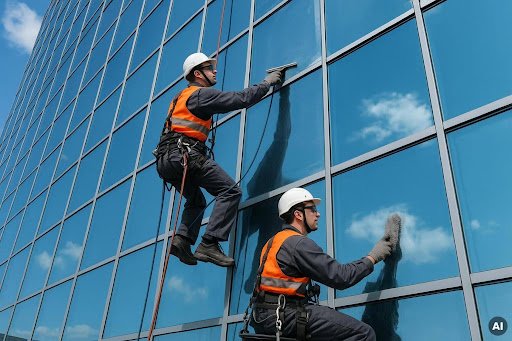
Commercial property managers must balance a clean appearance with budget limits, site access, daily operations, and tenant satisfaction. Facilities teams often choose rope access over traditional methods because it offers flexible planning with little effect on the main activities inside the building.
Whether the property is in a narrow city alley or a busy office complex, industrial rope access makes outside maintenance easier by removing the need for large mechanical equipment.
Reaches Difficult Areas Without Permanent Scaffolding
Building scaffolding around a multi-storey office block is expensive, disruptive, and slow. It can take days or weeks to install, block views, create security concerns, and require costly council permits if it extends over pavements or roads.
Rope access, offered by specialists such as Rope Access in London, removes the need for temporary ground structures. Rope systems can be fixed to roof parapets, deadweight anchors, or structural steelwork without taking up space at ground level. After the work is finished, the ropes are removed or stored safely, leaving the area around the building open and clear.
Reduces Disruption to Tenants, Customers, and Traffic
Ground-level mobile elevating work platforms (MEWPs) can create many problems in busy commercial areas. They need wide exclusion zones, may block loading bays, produce noise and diesel fumes, and may require part of a road or footpath to close. At corporate offices, hotels, and retail sites, this equipment can discourage visitors and frustrate tenants.
Abseiling teams carry out most of their work high above the ground, causing very little disruption below. Apart from a small, clearly marked safety area beneath the active drop line, entrances can stay open, car parks can remain in use, and office workers hear very little noise while the outside glass is cleaned.
Rope Access Window Cleaning Safety Standards
Industrial rope access has one of the lowest rates of incidents and injuries in the wider work-at-height sector. It is not treated as an extreme sport. Commercial abseiling follows a controlled engineering process that uses separate safety systems to prevent one failure from causing an accident.
Every technician, item of equipment, and work movement follows legal standards, including the UK Work at Height Regulations 2005 and OSHA descent standards. These rules protect technicians, people inside the building, and members of the public below.
IRATA Training and Technician Competence
The main international standard for rope access work comes from the Industrial Rope Access Trade Association (IRATA), which was formed in the 1980s. IRATA qualifications belong to individual technicians, not cleaning companies. They require practical training, medical checks, and independent assessments.
The qualification system has three levels:
- Level 1: Workers trained in rope movement, equipment checks, and basic self-rescue. They work under close supervision.
- Level 2: Experienced technicians who can handle advanced rigging, rope deviations, tensioned lines, and more difficult rescues involving another worker.
- Level 3: Experienced site supervisors with strong knowledge of work-at-height law, risk reviews, complex rigging, and rescue planning. Every rope access site needs an active Level 3 safety supervisor on duty.
Pre-Work Risk Assessments and Method Statements
Before a technician connects a carabiner to an anchor line, the team prepares site-specific risk assessments and method statements, often called RAMS. These documents review the environmental and building hazards linked to the work.
Engineers check wind conditions, the shape of the building, electrical systems, working HVAC outlets, hot air flues, and pedestrian movement at ground level. Clear work limits are set before the job begins. Work stops during high winds that make ropes move too much, lightning storms, or heavy rain that affects visibility and grip.
Anchor Checks, Equipment Inspections, and Rescue Plans
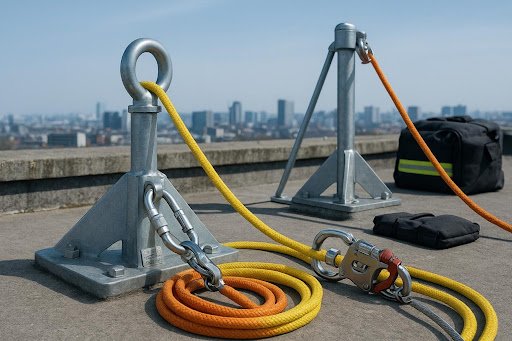
Safe rope access work depends on three main areas: strong anchors, reliable equipment, and a clear rescue plan. Anchor points must be certified, tested, and labelled to carry high dynamic loads, such as the OSHA 5,000 lb / 22.2 kN standard or regional standards such as EN 795. If fixed eyebolts are not available, qualified technicians can use portable deadweight trollies or structural beam clamps for safe rigging.
Personal protective equipment (PPE), including dynamic and low-stretch kernmantle ropes, ascenders, backup fall arrestors, harnesses, and approved helmets, is checked each day and recorded in equipment logs. Every rope access plan also includes a tested rescue process. Technicians do not depend on public emergency services for an immediate rope rescue. They carry the rigging equipment needed to recover a coworker within minutes.
How a Rope Access Window Cleaning Visit Works
A rope access window cleaning visit follows a planned industrial process. Professional teams do more than arrive with buckets and squeegees. They use several work stages to cover the full surface, protect the building, and coordinate with people on site.
From the first building checks to the final handover, each stage is planned to produce a high-quality clean while protecting the property.
Site Assessment and Access Planning
The work starts with a technical site survey before cleaning begins. Project planners and rope safety supervisors visit the property to check roof hatches, review the load capacity of parapet walls, inspect certificates for anchor bolts, and examine pedestrian areas around the building.
At this stage, the team prepares a drop plan showing the descent routes, anchor positions, and rope protection needed around sharp roof edges. Building managers receive a tenant communication plan, usually with notices sent 5 to 7 days before work starts. This gives occupants time to close blinds and safely lock external vents or automatic window controls.
Water-Fed Poles, Pure-Water Systems, and Squeegees
Technicians choose cleaning tools based on the building design and the type of glass coating. Traditional squeegees and microfibre applicators remain useful for heavy dirt, frames, and decorative sills where direct scrubbing is needed.
For large areas of glass, technicians often use water-fed poles supplied with high-quality pure water. The water passes through several filters and reverse osmosis (RO) systems to remove dissolved solids, calcium, and minerals. De-ionised water binds with dirt and dries without spots, so workers can often clean without chemical detergents. It also leaves no soapy film that could attract more airborne dust.
Glass Washing, Squeegee Cleaning, and Spot Removal
On cleaning days, the team marks a safe exclusion area at ground level, identifies the drop routes, and checks the roof anchors before setting up the two-rope lines. Technicians descend in controlled stages and apply pure water or environmentally friendly cleaning solutions to remove organic growth and traffic film from the glass and mullions.
They work from top to bottom, using overlapping squeegee strokes and then detailing the edges with microfibre cloths to stop drips. Marks such as bird droppings, tree sap, paint spray, and sealant are treated separately with glass scrapers and specialist cleaning products. This restores clear glass before the technician moves to the next drop area.
How Regular Cleaning Supports Commercial Property Maintenance
Regular window and façade cleaning is more than a cosmetic expense. It forms part of basic preventative property care. Exterior surfaces face constant exposure to the weather and pollution, so regular cleaning can slow chemical damage before it becomes a building repair issue.
Because rope access places trained technicians close to every part of the façade, each cleaning visit can also include a useful visual inspection at height.
Protects Glass, Frames, Seals, and Façade Finishes
Glass and anodised architectural metals can suffer from long-term chemical damage. Air pollution, acid rain, and salt from coastal air slowly mark glass surfaces and can cause lasting cloudiness. If mineral deposits stay on the glass for months, direct sunlight can harden them. Removing them may then require expensive glass restoration or replacement of the pane.
Long-term dirt can also damage rubber gaskets and silicone sealants around the glass. This may cause them to become brittle, allow water into the building, and create heat loss. Regular cleaning removes these harmful materials and can extend the working life of curtain-wall parts, powder-coated finishes, and structural frames.
Identifies Cracks, Failed Sealants, and Loose Components
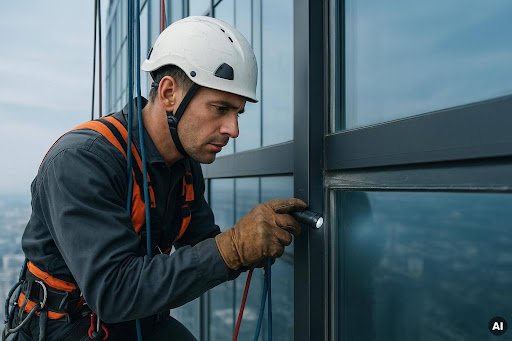
During a normal abseil, technicians view every joint, fixing, panel, and seal from only inches away. Ground-level checks and drone surveys cannot provide the same close view. Technicians can spot fine cracks in glass, worn silicone seals, damaged masonry, rusty cladding brackets, and loose decorative panels that could create safety risks.
Reliable rope access contractors record these problems in post-cleaning handover reports. The reports can include clear photographs and GPS or grid locations. This information helps facilities managers arrange focused repairs before small seal failures become major water leaks or falling-material incidents.
What Affects the Cost and Schedule of Rope Access Window Cleaning?
Anyone ordering rope access cleaning needs to understand the factors that affect price and project time. Unlike indoor cleaning, high-level exterior work depends on the building shape, property size, exposure to pollution, and weather.
A clear quote covers more than the number of square metres. It also reflects the site work needed to complete the job safely and in an organised way.
Building Height, Window Count, and Façade Complexity
The total area of exterior glass is only the starting point for working out the price. A 30-storey building with a flat, even glass façade may take less time than a 10-storey building with ledges, stepped balconies, recessed windows, and many anchor changes.
Each time a technician needs to set up a difficult rope deviation, move around a corner, or work around brise-soleil panels, the job takes longer. Other site details also affect the crew size and equipment needed. These include the number of anchor points, ease of roof access, protection for people at ground level, and rules for handling wastewater.
How Often Should Commercial Windows Be Cleaned?
The right cleaning schedule depends on the location, local pollution, and the appearance standards of the property. Many facilities managers use a schedule based on the type of building and its surroundings:
| Building Type & Environment | Recommended Cleaning Frequency | Primary Contaminants Managed |
| Urban High-Rise HQ (Heavy Traffic / City Centre) | Quarterly (3 to 4 times per year) | Diesel exhaust particles, brake dust, and air pollution. |
| Coastal Commercial Properties | Every two months to monthly | Airborne salt crystals, wind-blown sand, and hard mineral deposits. |
| Suburban Office Parks & Light Industrial | Twice a year | Pollen, seasonal rain marks, and general environmental dust. |
| Luxury Retail, Hotels, & Ground Atriums | Monthly (Glass) / Every two weeks (Entryways) | Fingerprints, street dust, runoff marks, and splashback from pedestrians. |
Seasonal cleaning plans, such as full deep cleans in early spring and early autumn, can keep the building looking presentable while helping property managers control maintenance spending.
How to Choose a Commercial Rope Access Window Cleaning Team
Choosing a rope access contractor requires careful checks. Allowing workers to operate hundreds of feet above busy streets carries serious responsibility, so facilities teams need a company that follows high safety standards.
Checking certificates, safety records, and work procedures helps protect the property owner from serious liability and poor cleaning results.
Check IRATA or Relevant Industry Qualifications
The main qualification to check for a commercial high-rise cleaning team is IRATA compliance, or a national equivalent such as SPRAT. Facilities managers should confirm that each technician has a current individual IRATA logbook and certificate card for the correct level.
Also check that the contractor will have a certified IRATA Level 3 Safety Supervisor on site for all rigging and cleaning work. Level 3 supervisors check the main anchor arrangements, lead toolbox talks, watch for changes in the weather, and manage emergency rescue work on site.
Request Evidence of Insurance and Safety Procedures
Do not hire a high-rise cleaning contractor without checking its current health, safety, and insurance documents. A reliable rope access provider should supply public liability insurance, employer’s liability insurance, and site-specific RAMS prepared for the property.
Choose a company with clear safety reporting systems. Ask to see its dropped-object controls, such as tool lanyards and secured buckets, equipment service records, and written emergency plans. A contractor that tracks safety risks and records safety observations is more likely to provide safe, well-managed façade work.